

02 · The app
It tells you when it isn't sure
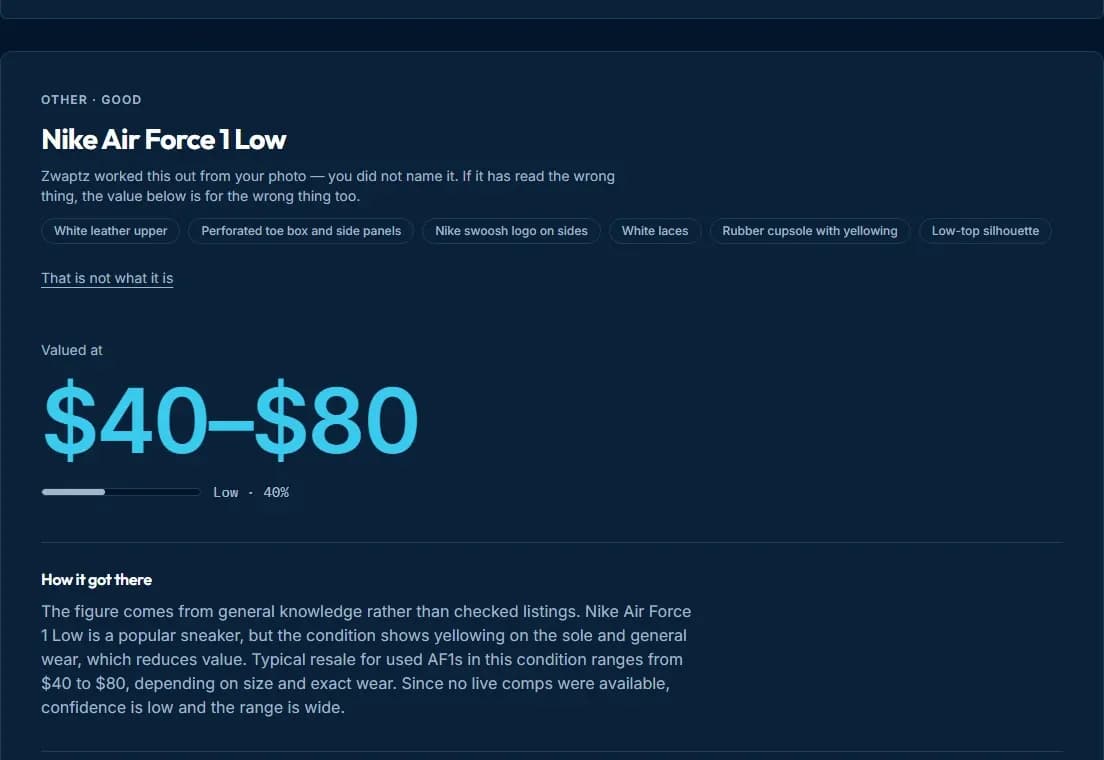
Every valuation arrives as a range with a word beside it: Low, Medium or High. The word is not a grade for the item. It is how much the range should be trusted.
High
$300–$380
A thing with a model number, made in quantity, sold often. A bicycle, a games console, a power tool. The range is narrow because the market is legible.
Medium
$120–$260
Identified confidently, but condition or edition moves the figure a long way. Most second-hand things live here, and so does most of what you own.
Low
$25–$260
Something could not be read — a maker's mark, an edition, whether a part is original. The range is wide because the honest answer is wide.
A wide range is an answer
A wide range is the honest answer.
It is not a failure and it is not the system apologising. It is the system telling you that the difference between two readings of your thing is real, and that you should find out which one it is before trading against either.
A confident single figure on an object nobody could identify would be worse in every direction.
There is a worked example of exactly that case — a pocket knife with no readable mark, valued between twenty-five and two hundred and sixty dollars — on real trades.

“That is not what it is”
Every valuation carries that line, and it is a button. Press it, name the thing yourself, and it is valued again from your answer rather than from the photograph.
A model reading one picture gets this wrong in ways you will spot instantly. The wrong edition. The wrong colour. Sometimes the case rather than what is inside it.
You know what your own thing is. The quickest correction on the site is you typing it.
Where confidence is capped, and why
A valuation has three stages: identify the thing, find what comparable ones sold for, turn that into a range. The middle stage is not connected yet.
So today every range is produced from what the model already knows about a market rather than from sales it checked, and confidence is held down to match — deliberately, whatever the model thought of its own work. Each valuation says which of the two it is, and shows no comparables when it has none.
In practice that means one word: every valuation on Zwaptz today reads Low. Medium and High exist in the scale and nothing can reach them while the middle stage is missing.
Connecting that stage is the first thing the campaign pays for. When it is connected, the ranges narrow and the other two become reachable.
Two appraisals of the same photograph can differ while comparables are unconnected — we have watched one tent return $25–$60 and then $9–$27. That spread is what low confidence means, and it is why a single appraisal is a starting point rather than evidence.