Point your phone at it
Point your phone at the thing you stopped using.
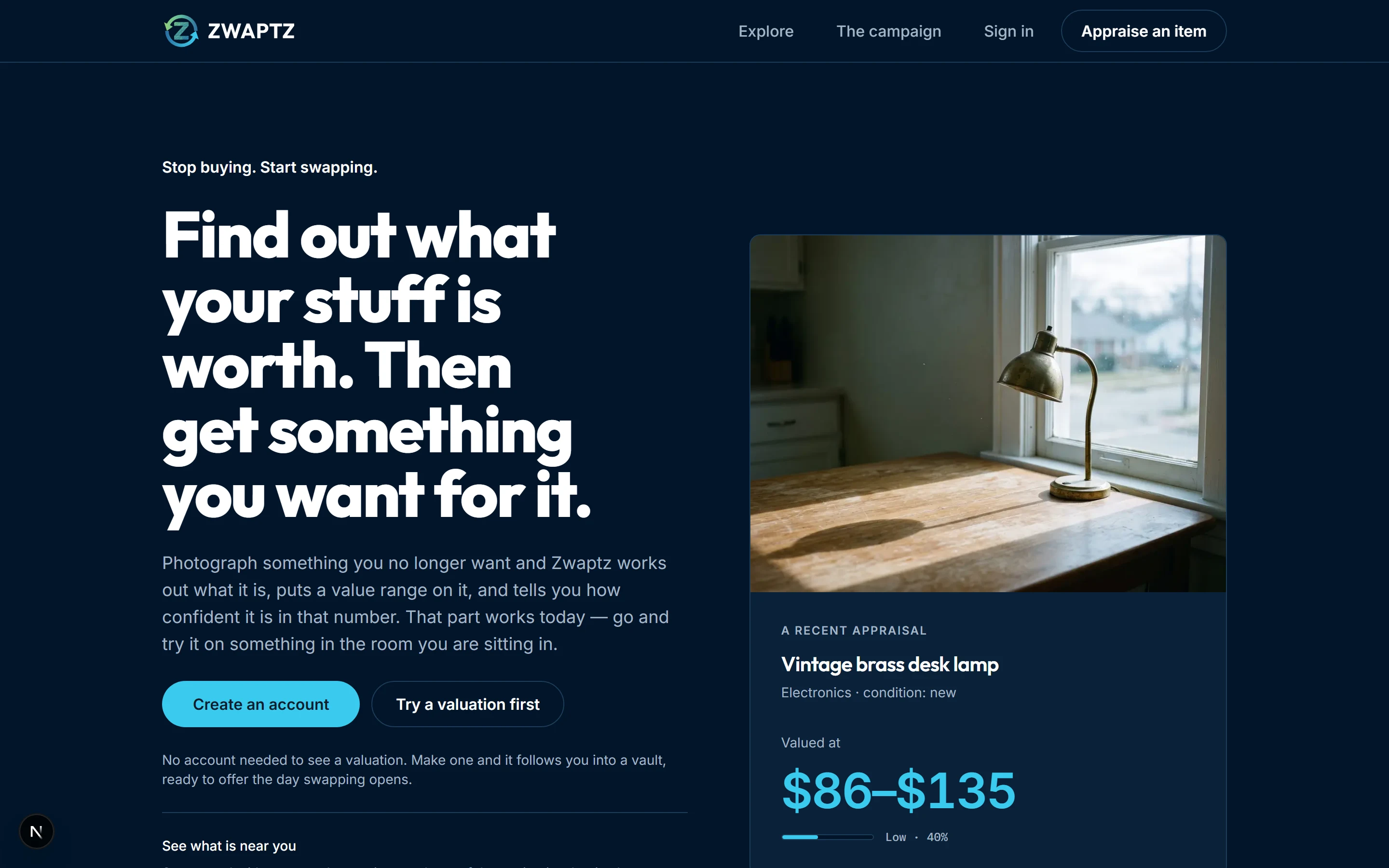
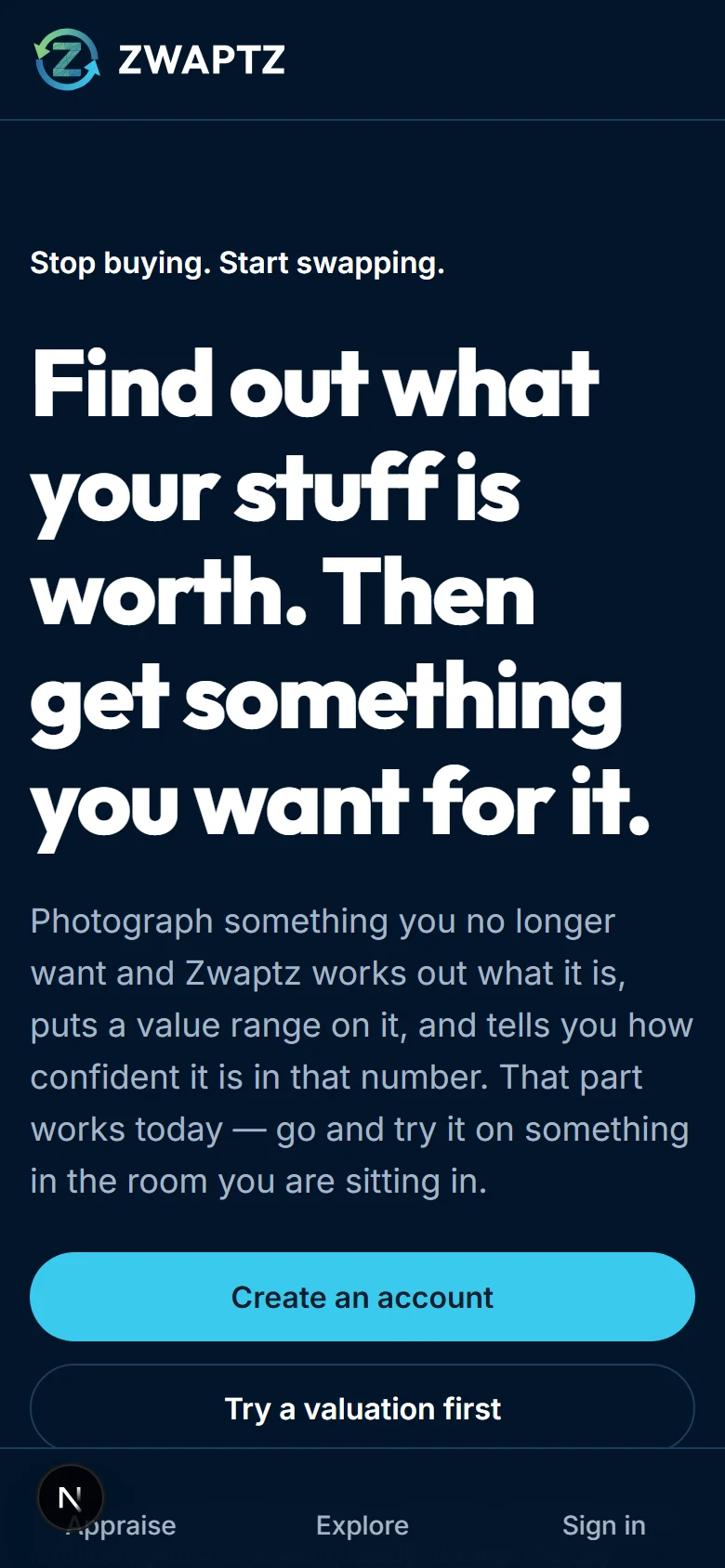
Find out what it is worth. Trade it for something you actually want. Twenty seconds from photograph to range, and no forms to fill in.
What it actually looks like
Every screen below is the running product, captured — not a mockup and not a drawing. Nothing here shows a feature that does not exist.
1 Point your phone at it
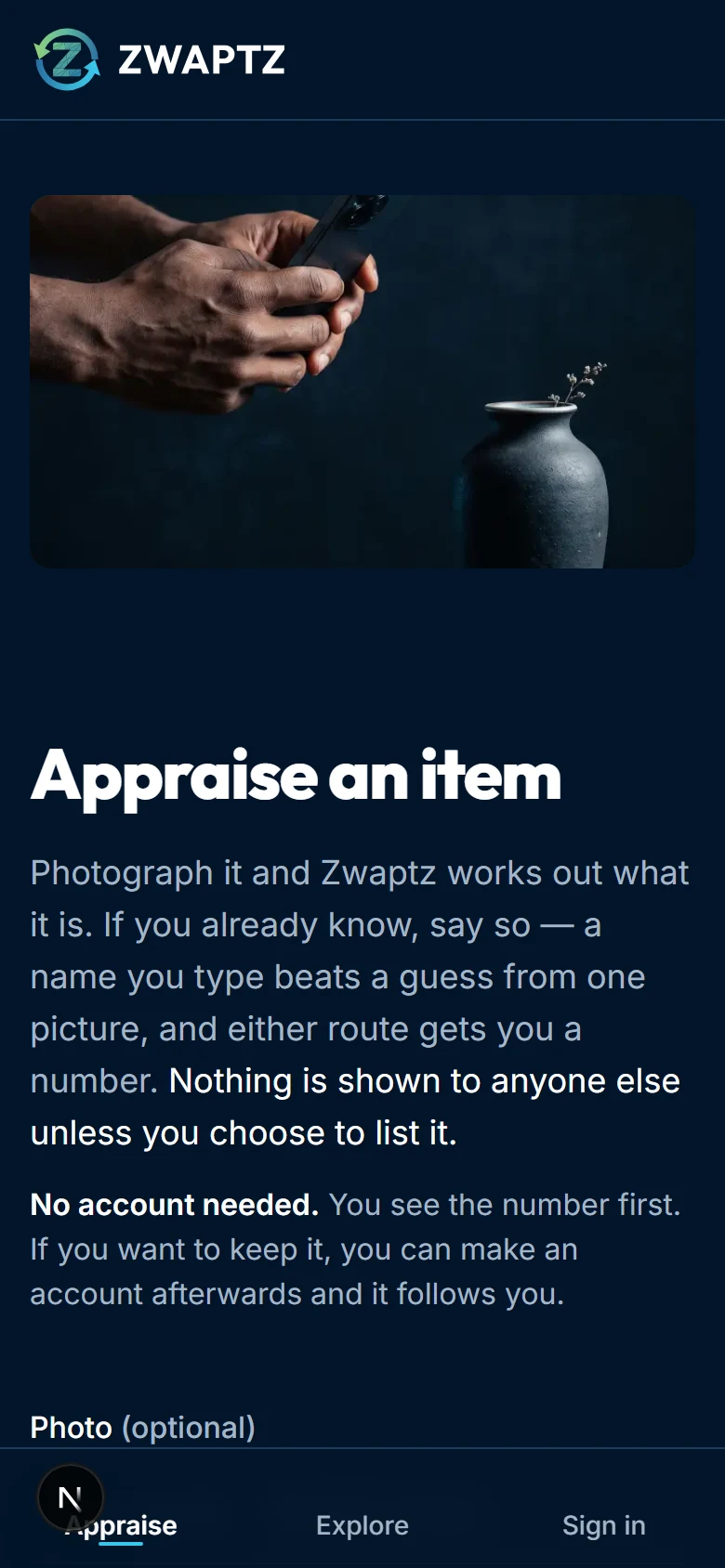
Make an account, photograph the thing, press the button. No forms to fill in.
2 Get a range, and a confidence
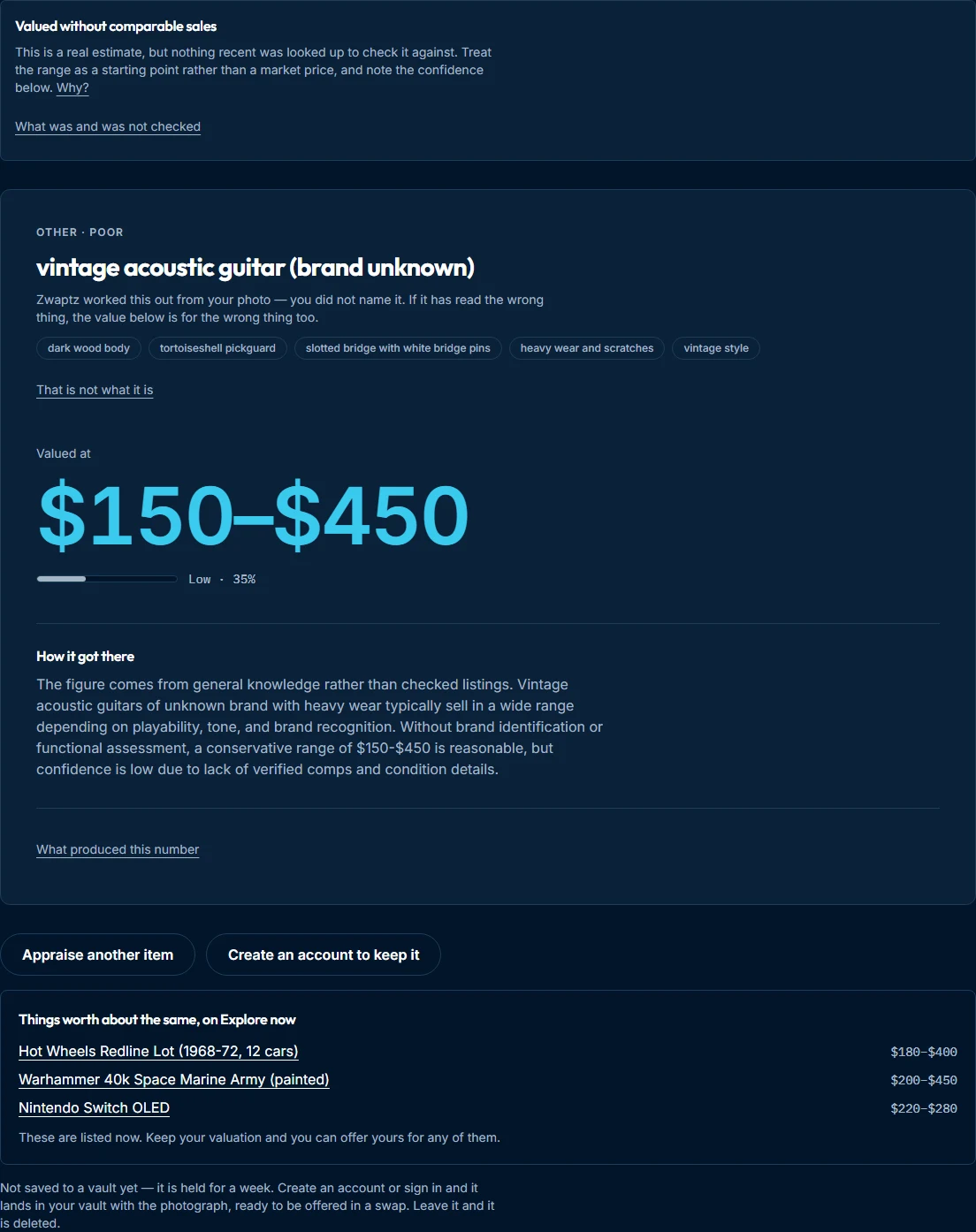
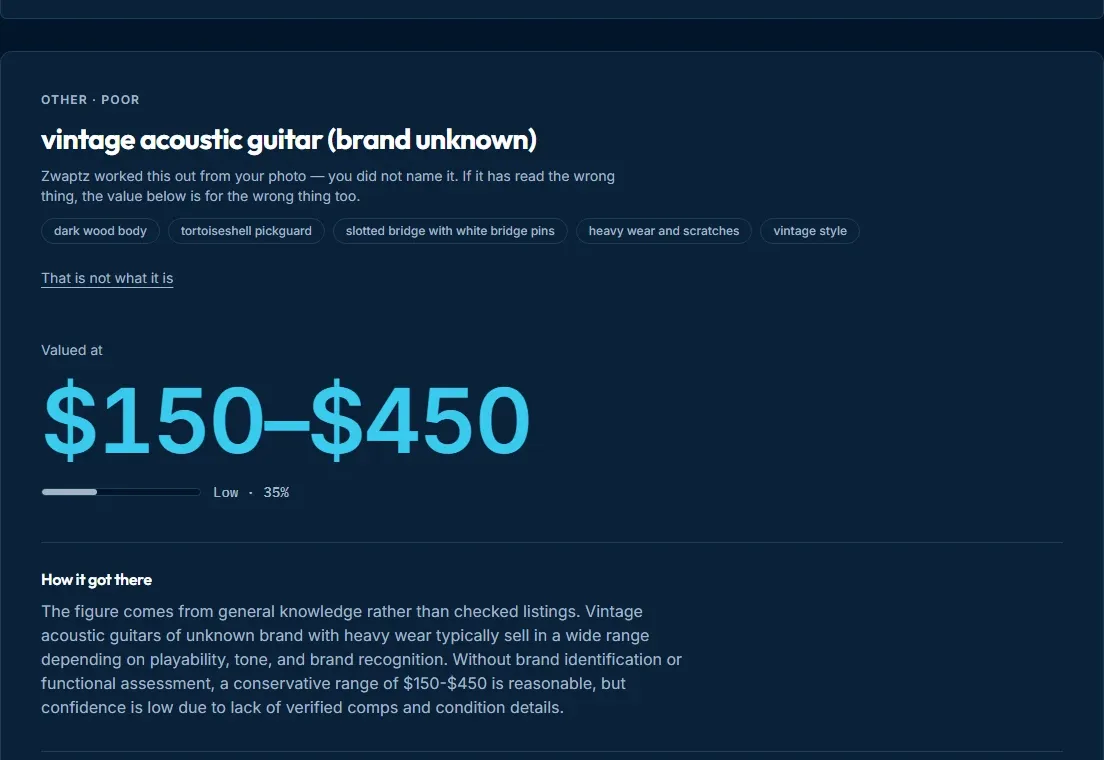
Not a price. A band, with Low, Medium or High beside it and the reasoning underneath.
3 See what it can become
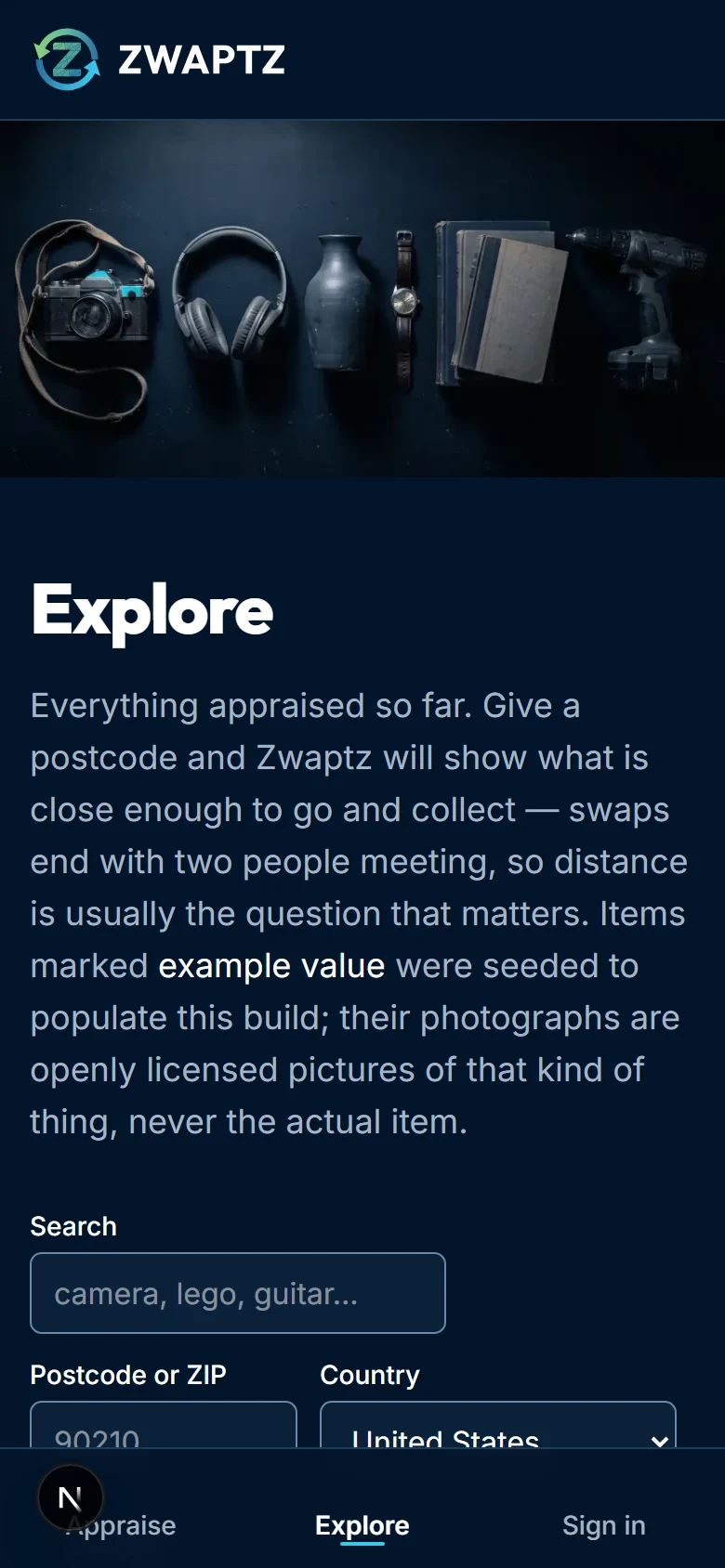
Everything inside your band is something your thing can turn into.
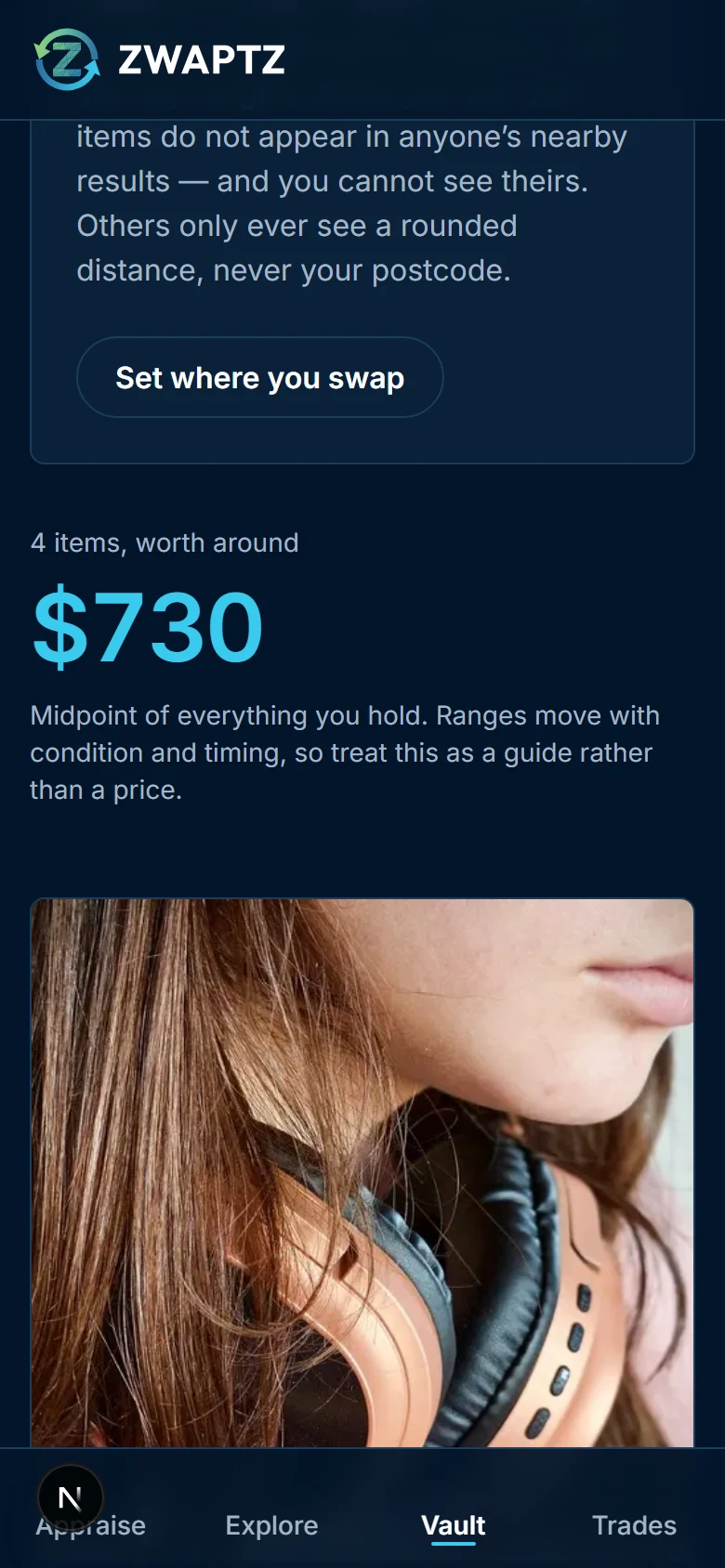
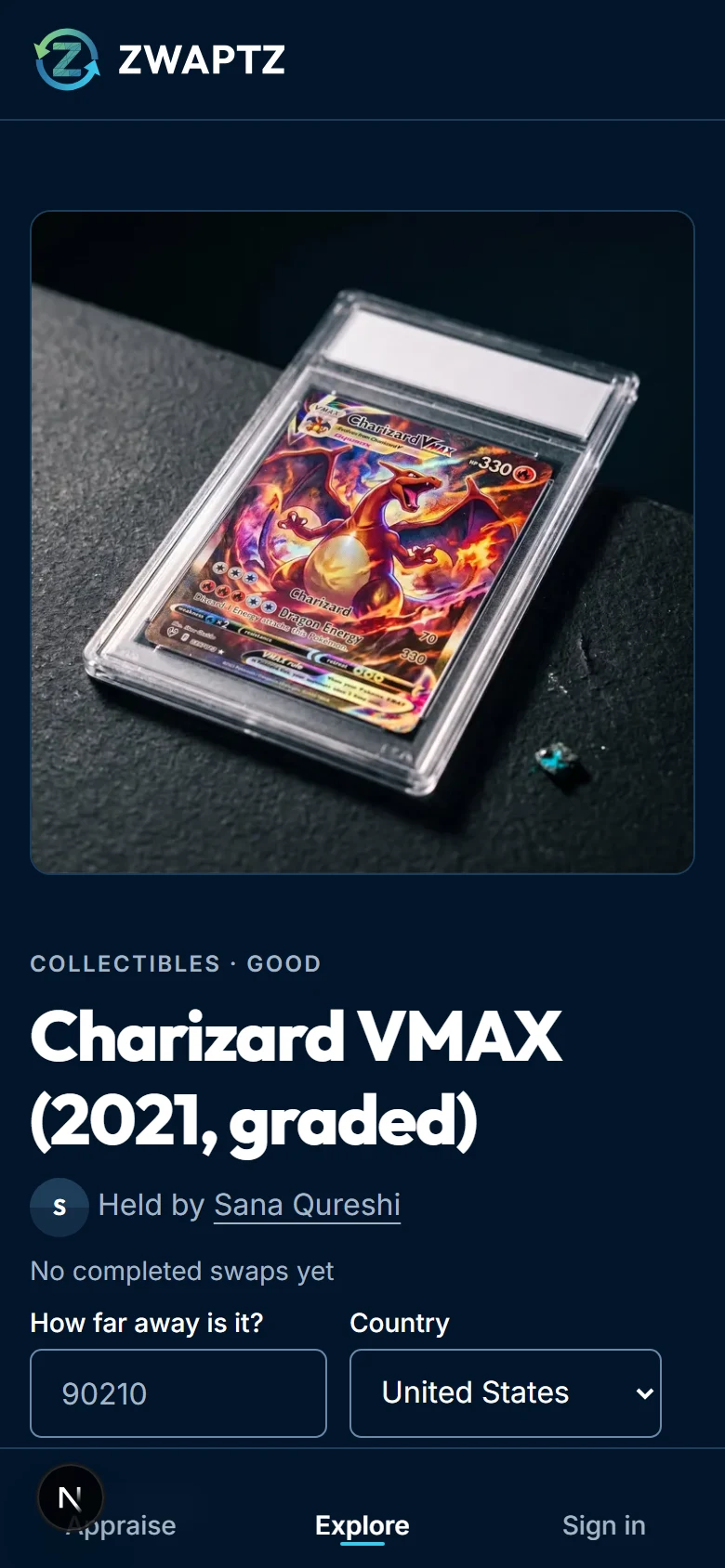
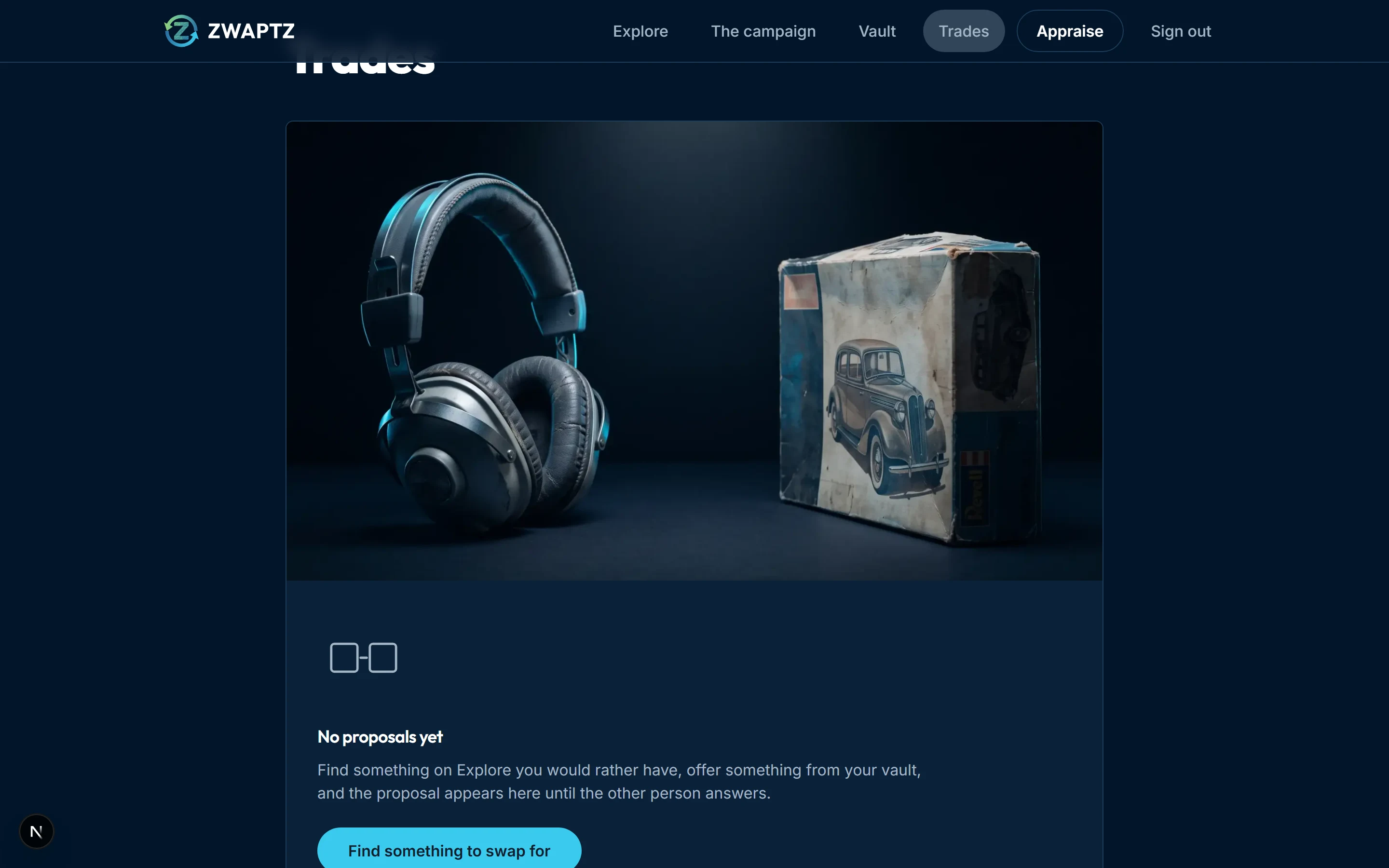
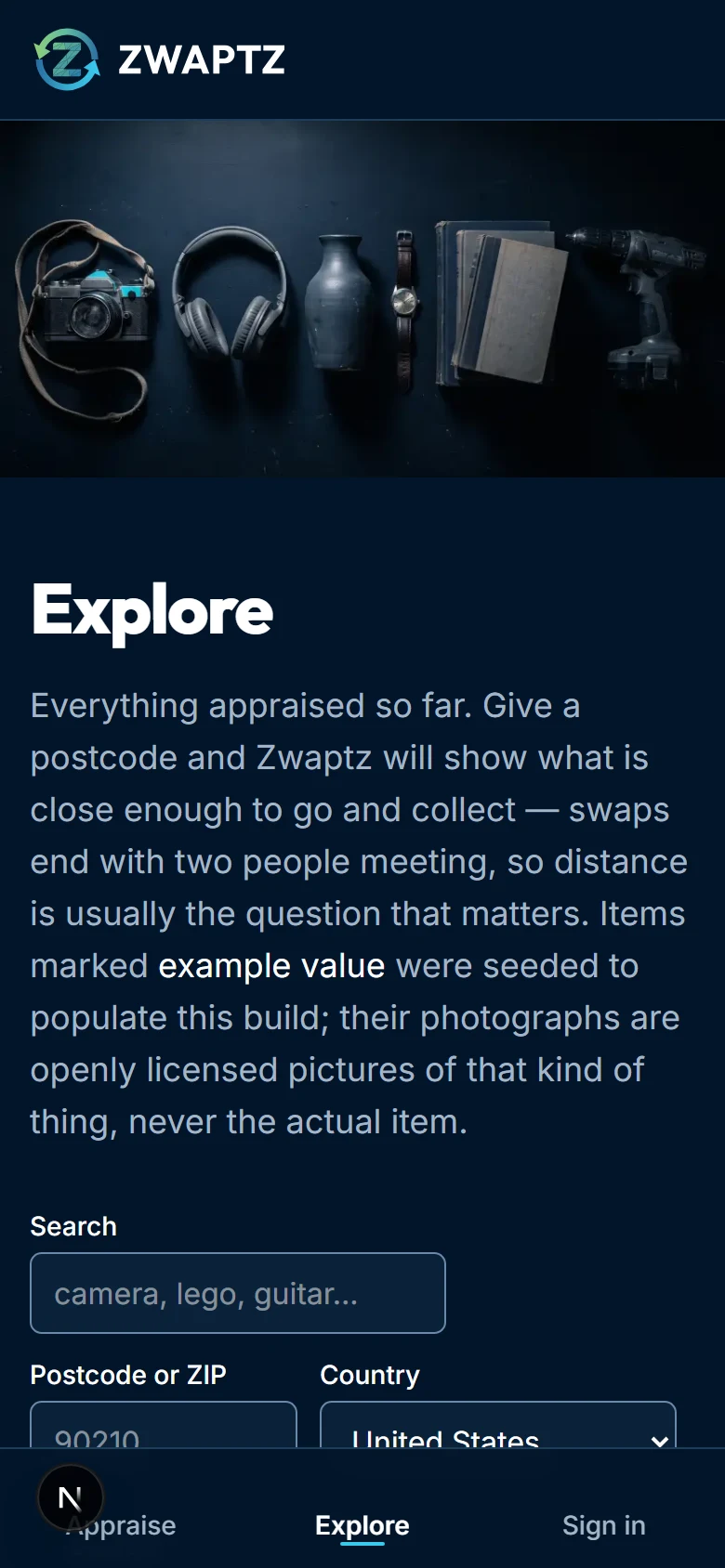
You never price your own things. You see what they turn into.
The appraisal
What can I get for this?
Point your phone at the thing you stopped using. Find out what it is worth. Trade it for something you actually want.


- You never price your own things.
- That is the part people find strange for about a minute. You do not have to decide what your bread maker is worth, defend the figure, or watch somebody talk you down from it.
- It works on the ordinary things
- Not only on the rare ones. Most of what people appraise is exactly what you would expect to find in a cupboard.
You never price your own things.
When it isn't sure
It tells you when it isn't sure
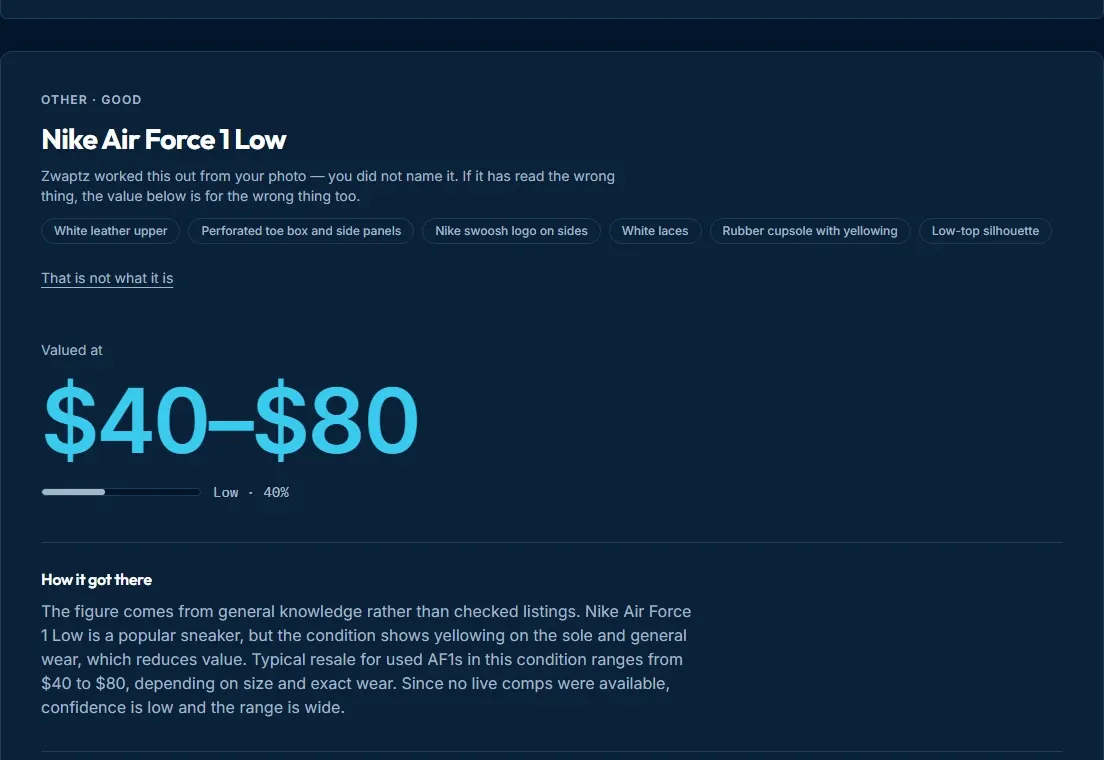
Every valuation arrives as a range with a word beside it: Low, Medium or High. The word is not a grade for the item. It is how much the range should be trusted.
- A wide range is the honest answer.
- It is not a failure and it is not the system apologising. It is the system telling you that the difference between two readings of your thing is real, and that you should find out which one it is before trading against either.
- “That is not what it is”
- Every valuation carries that line, and it is a button. Press it, name the thing yourself, and it is valued again from your answer rather than from the photograph.
- Where confidence is capped, and why
- A valuation has three stages: identify the thing, find what comparable ones sold for, turn that into a range. The middle stage is not connected yet.
A wide range is the honest answer.
The doorway
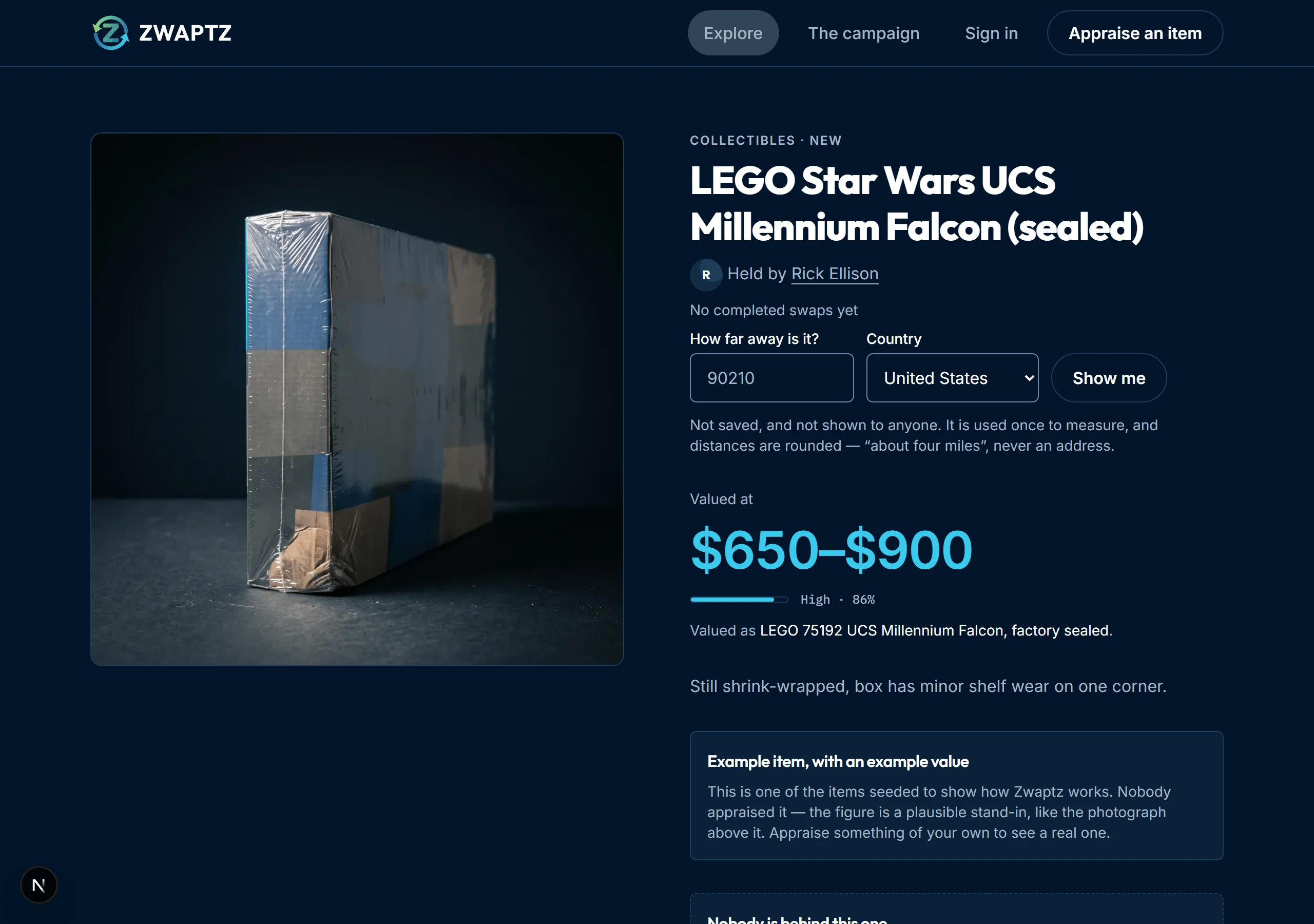
The range is a doorway
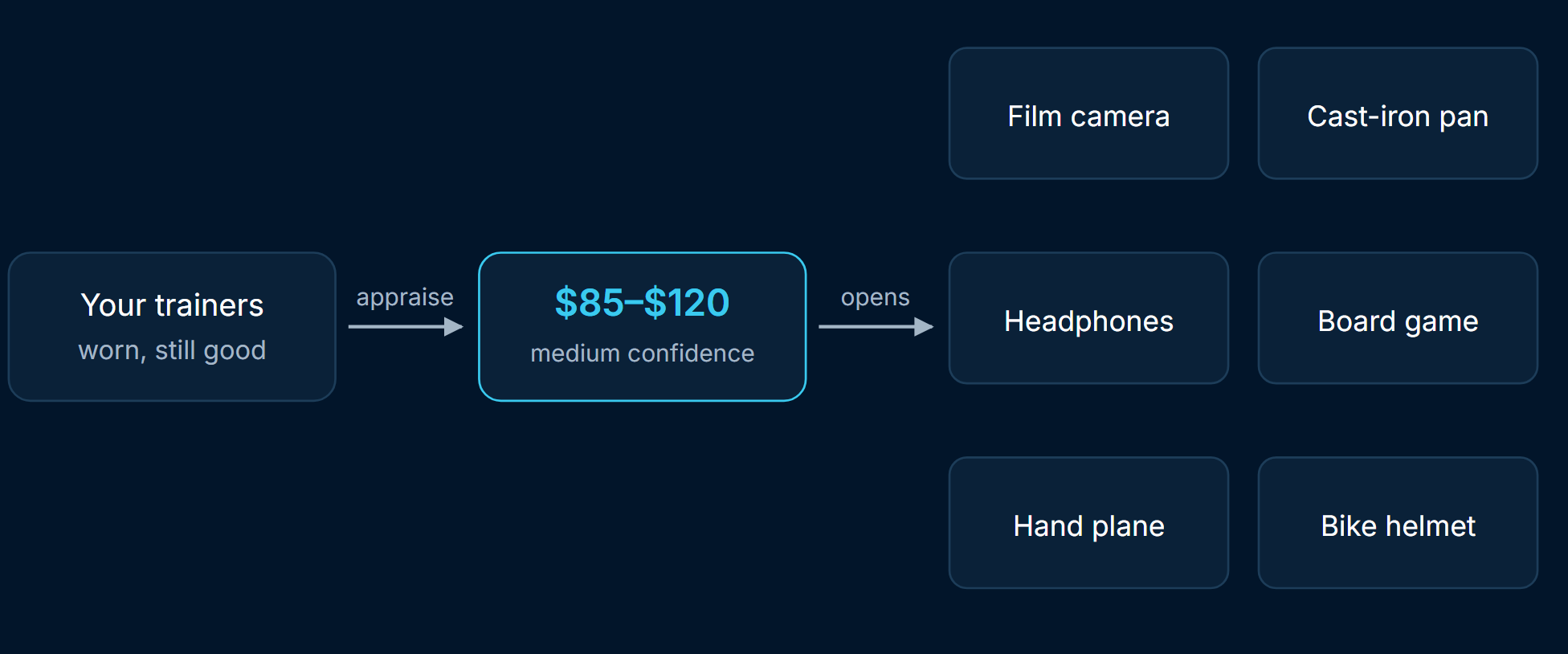
Your thing gets a band. Everything on Zwaptz inside that band is something your thing can become. Pick one, offer, and if they say yes you arrange to meet.
- This is not swapping your exact thing for their exact thing
- The old problem with trading things directly is that it needs a coincidence: you want theirs, they want yours, at the same moment, in the same town. That coincidence almost never happens, which is why nobody trades things.
- You see objects. Never a price tag.
- The dollar figure is plumbing. It runs underneath, it decides what you are shown, and then it gets out of the way.
- Two guitars, two different bands
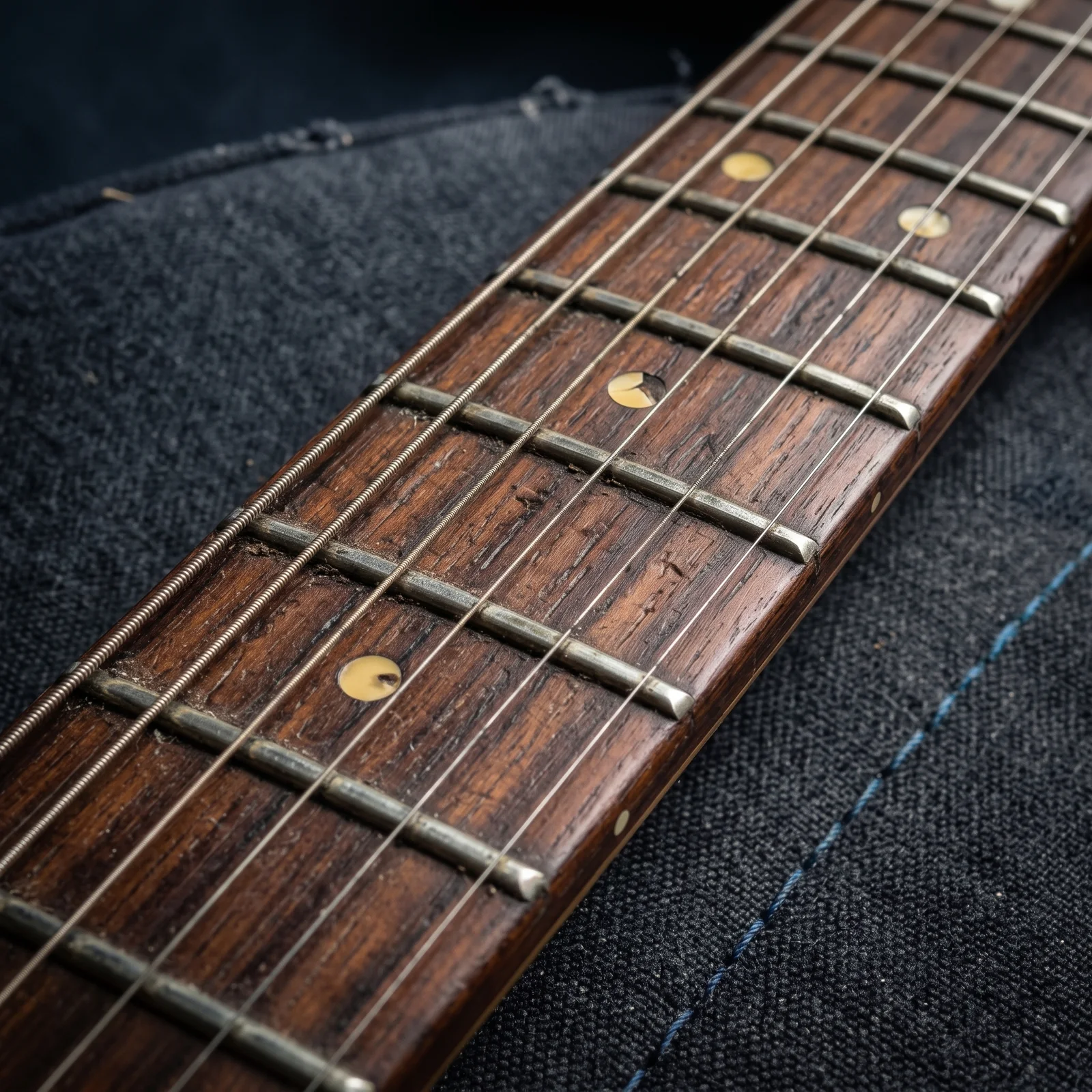
- An archtop and a Stratocaster, both looked after, both worth having. Neither is worth what the other is, and neither of their owners would agree on the difference.
- Bundles, when one thing is not enough
- A band does not have to be filled by one object. Two of your things can reach something bigger, and you can ask for two of theirs.
You see objects. Never a price tag.
The vault
Private until you say otherwise
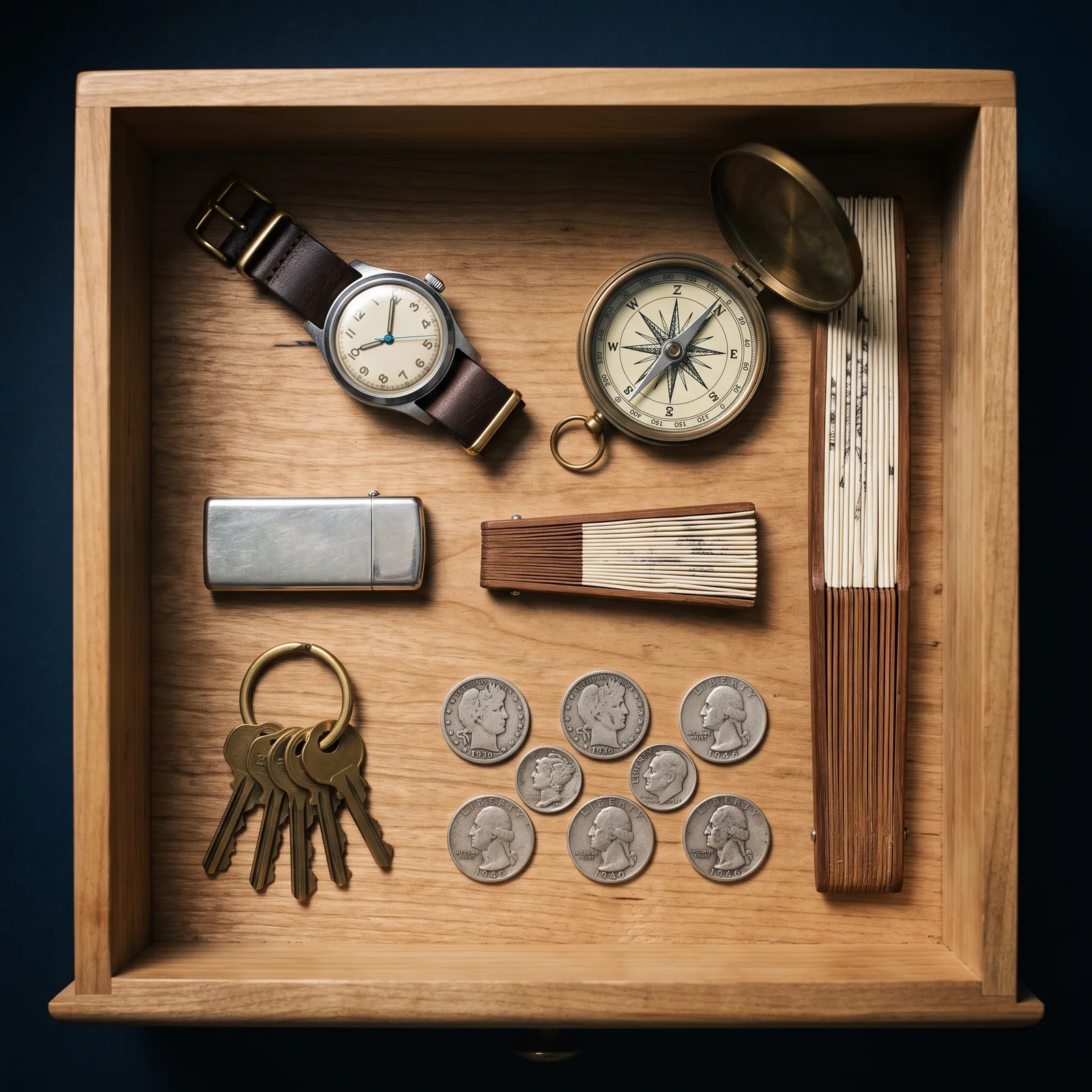
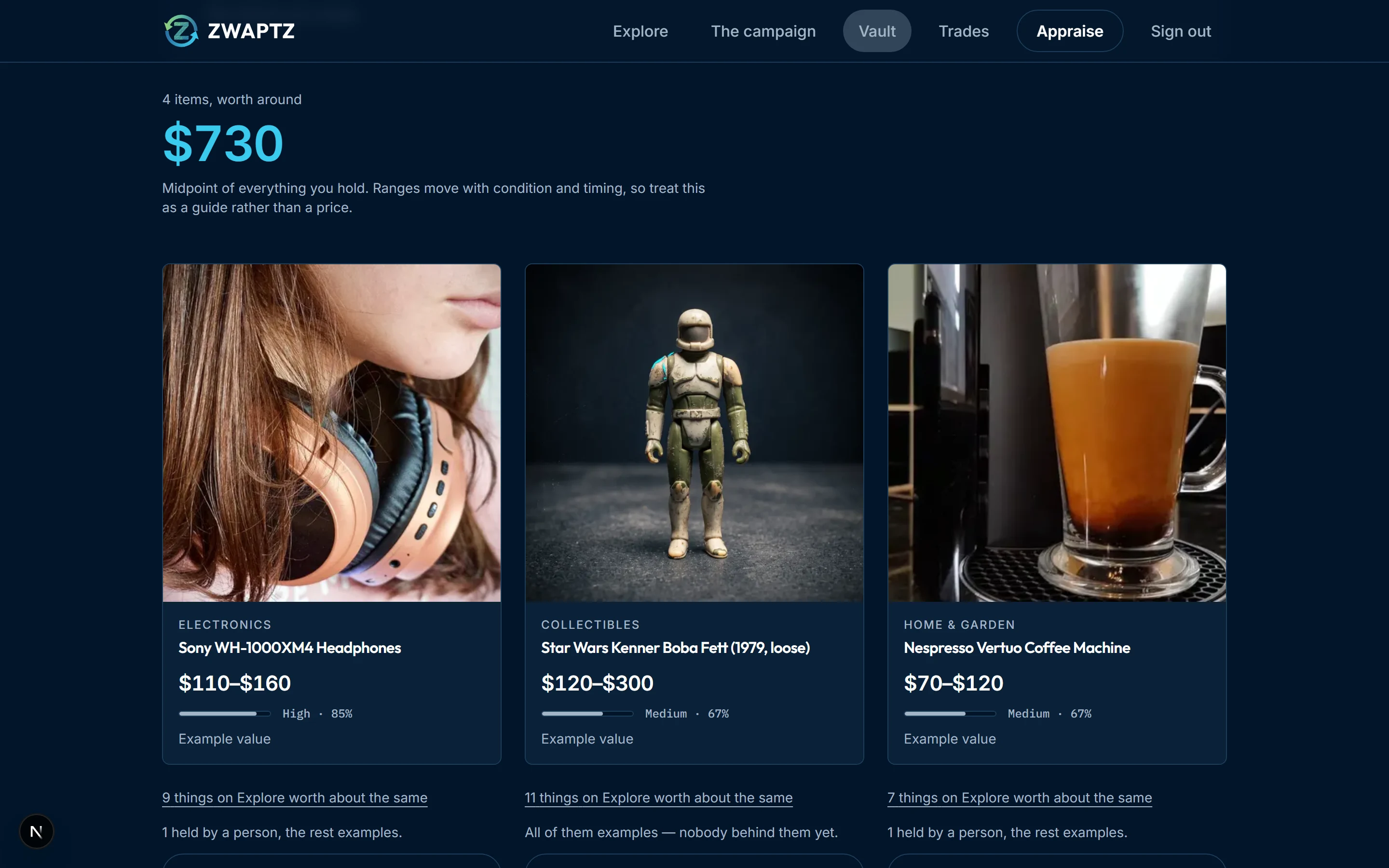
Appraising something puts it in your vault. It publishes nothing — not to the site, not to search engines, not to anybody nearby.

- Appraised
- It has a range and a confidence, and it sits in your vault. Nobody can see it, offer for it, or know it exists.
- Listed
- You have chosen to put it up. Now it appears to people near you, with a rounded distance and no location beyond that.
- Taken down
- You changed your mind. It goes back to being private, keeps its valuation, and nobody is told anything about it.
- Appraise ten things. List one.
- That is a normal afternoon on Zwaptz, and it is what the vault is shaped around. You go through a cupboard, find out what nine things are worth, discover that one of them is worth more than you thought, and put that one up.
- What it is actually for
- A running total of what you own, and a place where the answer stays put. Appraise the shelf once and you never have to wonder about it again.
- You can leave, and take it all with you
- Deleting your account is immediate and it takes the vault with it — the items, the photographs, the postcode, the address you signed up with.
Appraise ten things. List one.
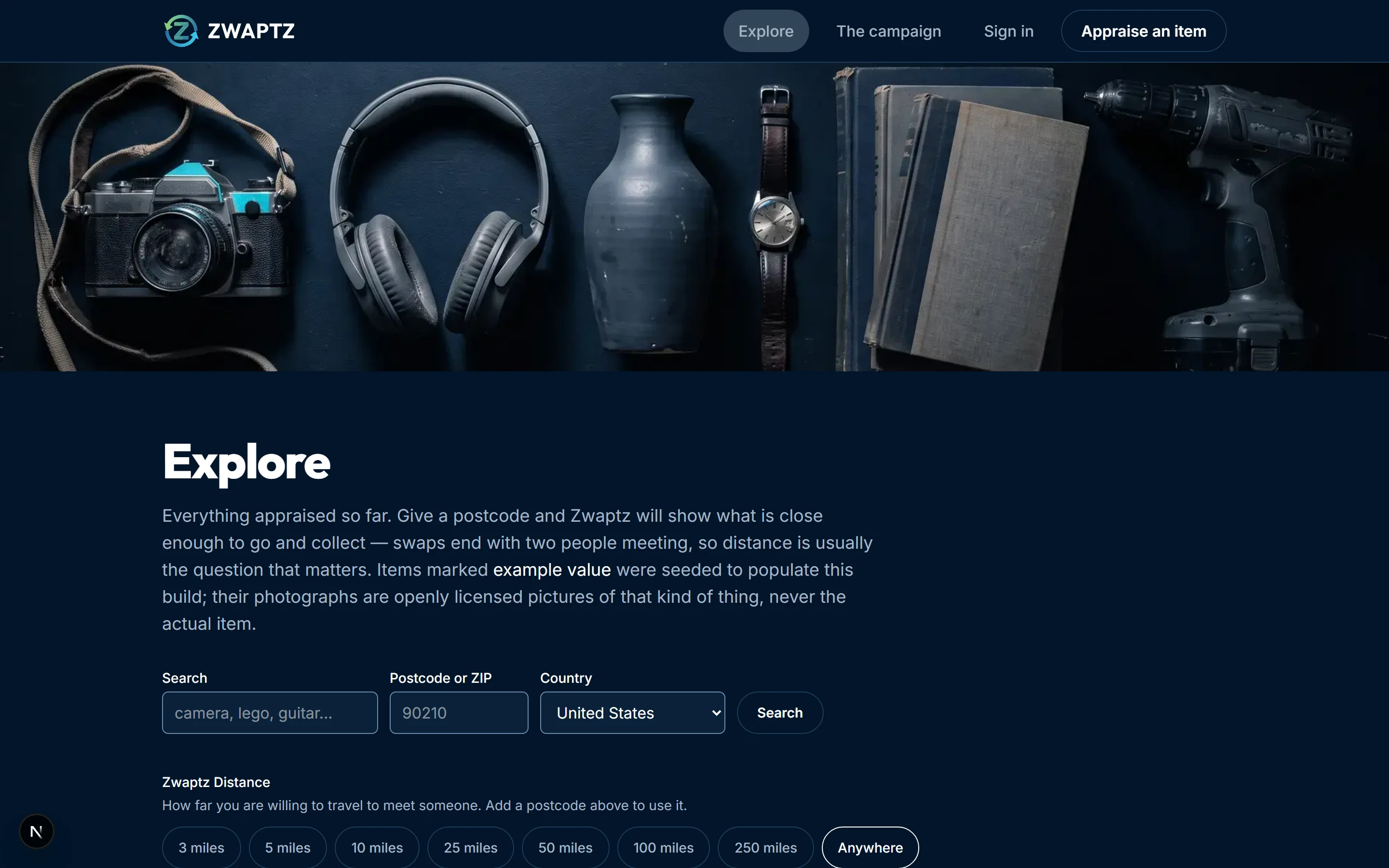
Four miles away
About four miles away
That is the whole of what you learn about where somebody is, and the whole of what they learn about you. A rounded distance, and nothing else.


- A map is a home address with extra steps.
- Every listing site draws one, usually as a circle rather than a point, and calls it approximate. Three overlapping circles from three of somebody’s listings is a house.
- What browsing is like
- By category, by distance, by what you typed. Every view is a plain web address you can send to somebody.
- Distance is the useful question
- Swaps end with two people meeting, so “is it near me” decides more than price does. A perfect match forty miles away is not a match.
A map is a home address with extra steps.
What people have
Eight reasons to have a look
Anything with a second-hand value. The eight below are how the site sorts it, but the sorting is not the interesting part — what is in each one is.
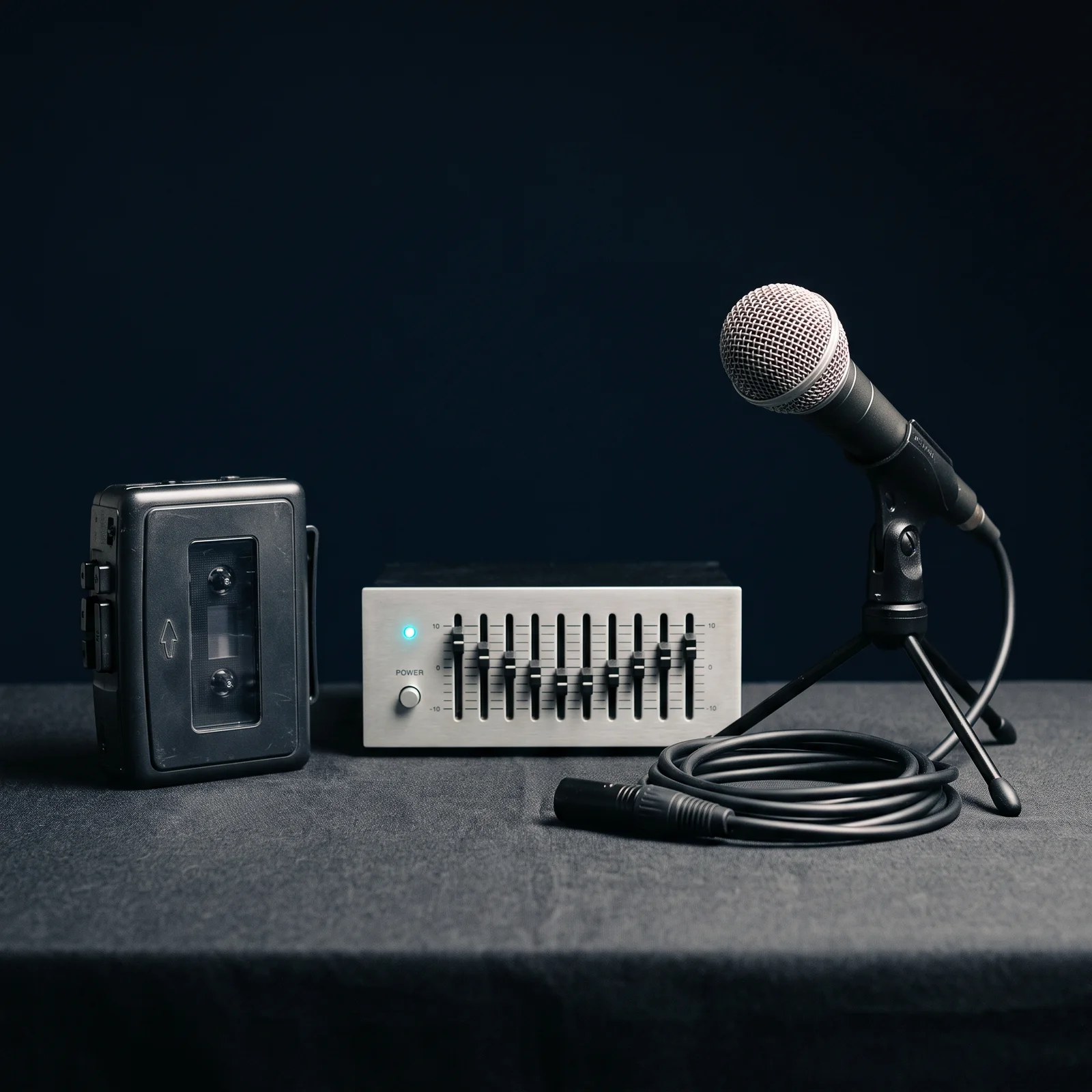


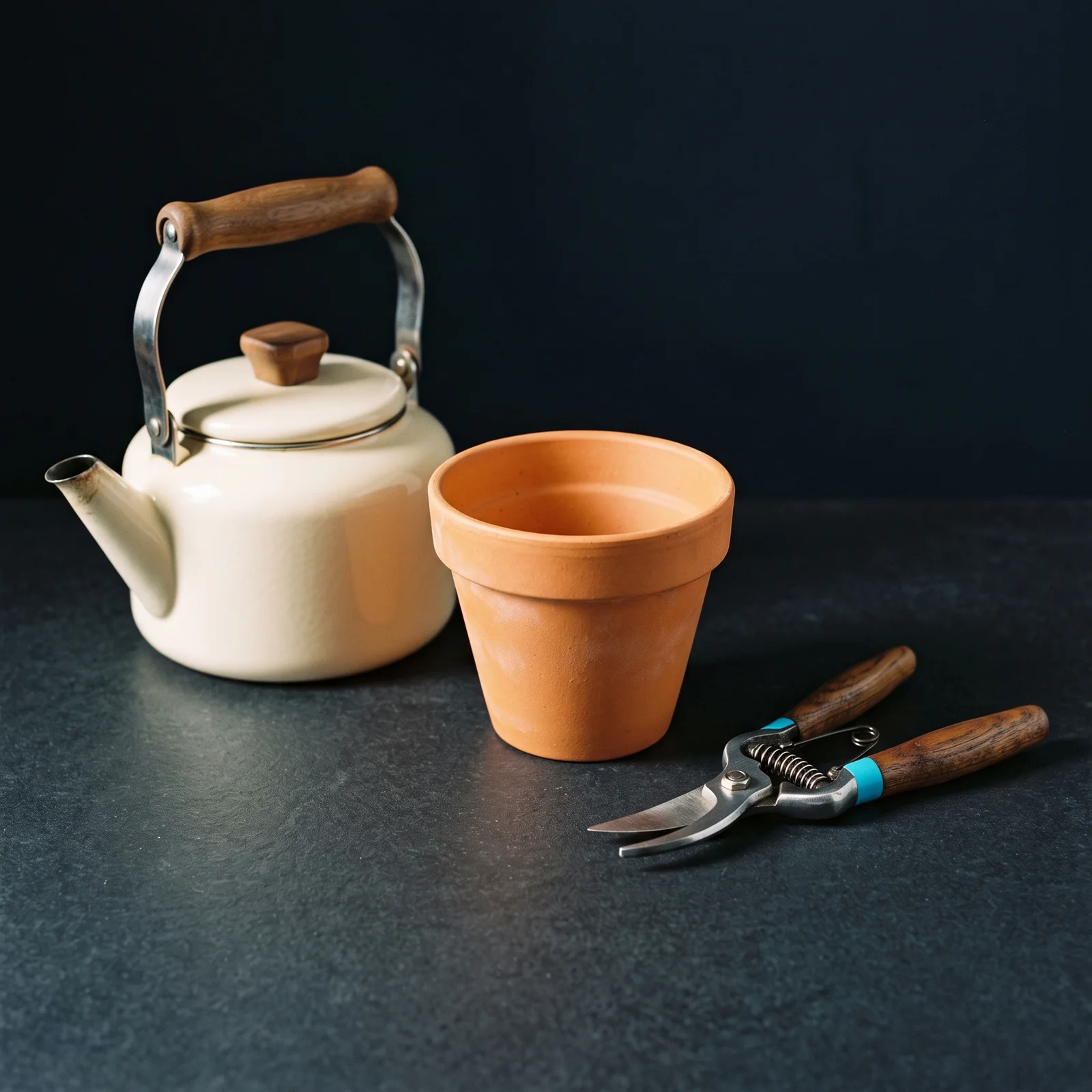
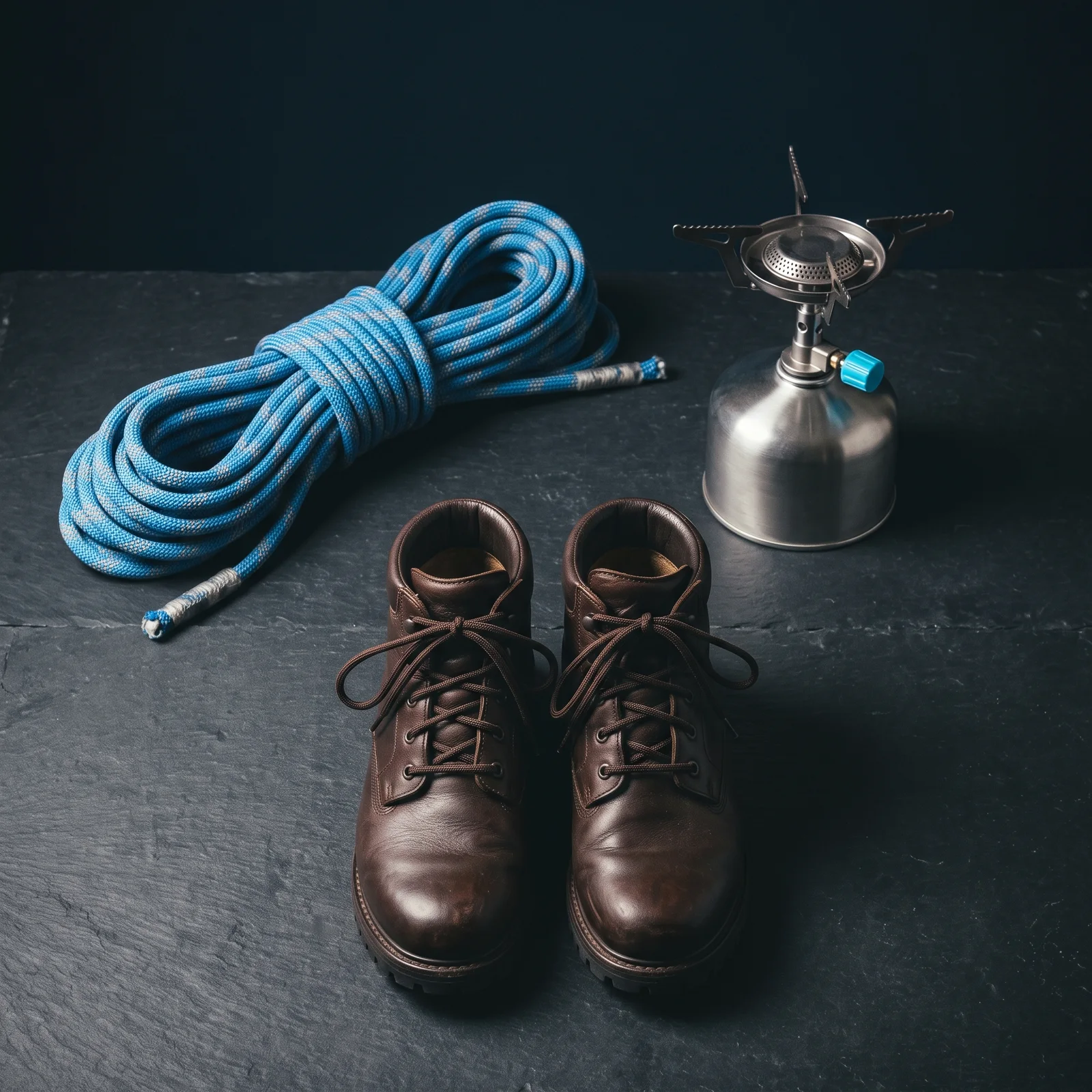
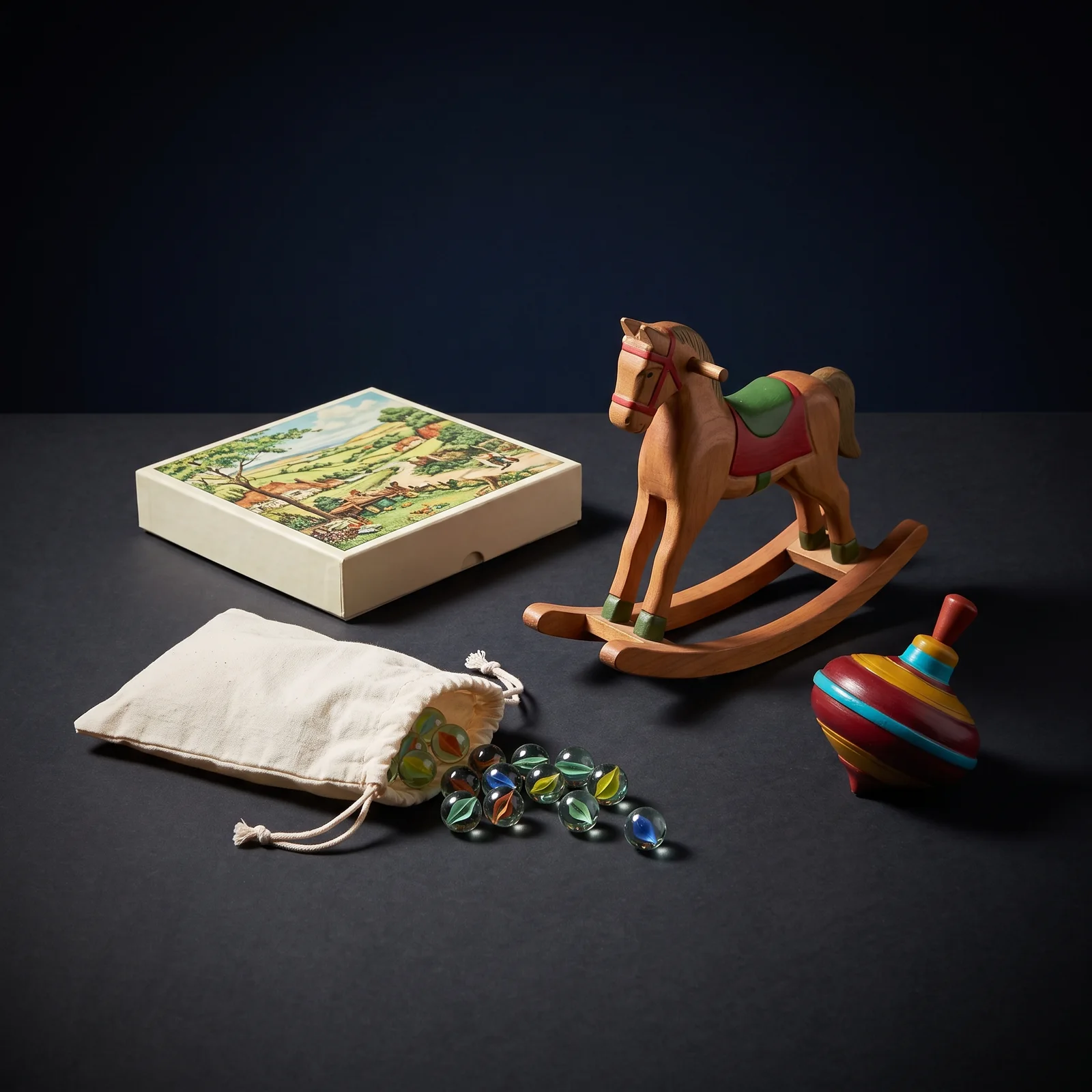

- Electronics
- The Walkman still works. So does the amplifier, the speaker and the microphone you bought for a podcast that lasted four episodes.
- Collectibles
- The spare. The one you upgraded from. The one that came in a box with something else you actually wanted.
- Fashion
- The jacket that fit the person you were in 2019. Good denim outlives several opinions about it.
- Home & Garden
- The bread maker, the second kettle, the terracotta pots, and the secateurs you own three pairs of.
- Sports & Outdoors
- One summer of climbing, one winter of running, and a stove that has boiled water twice.
- Toys & Games
- Used hard for eleven months and then abruptly never again. Somebody two streets away has a child the age yours was.
- Media
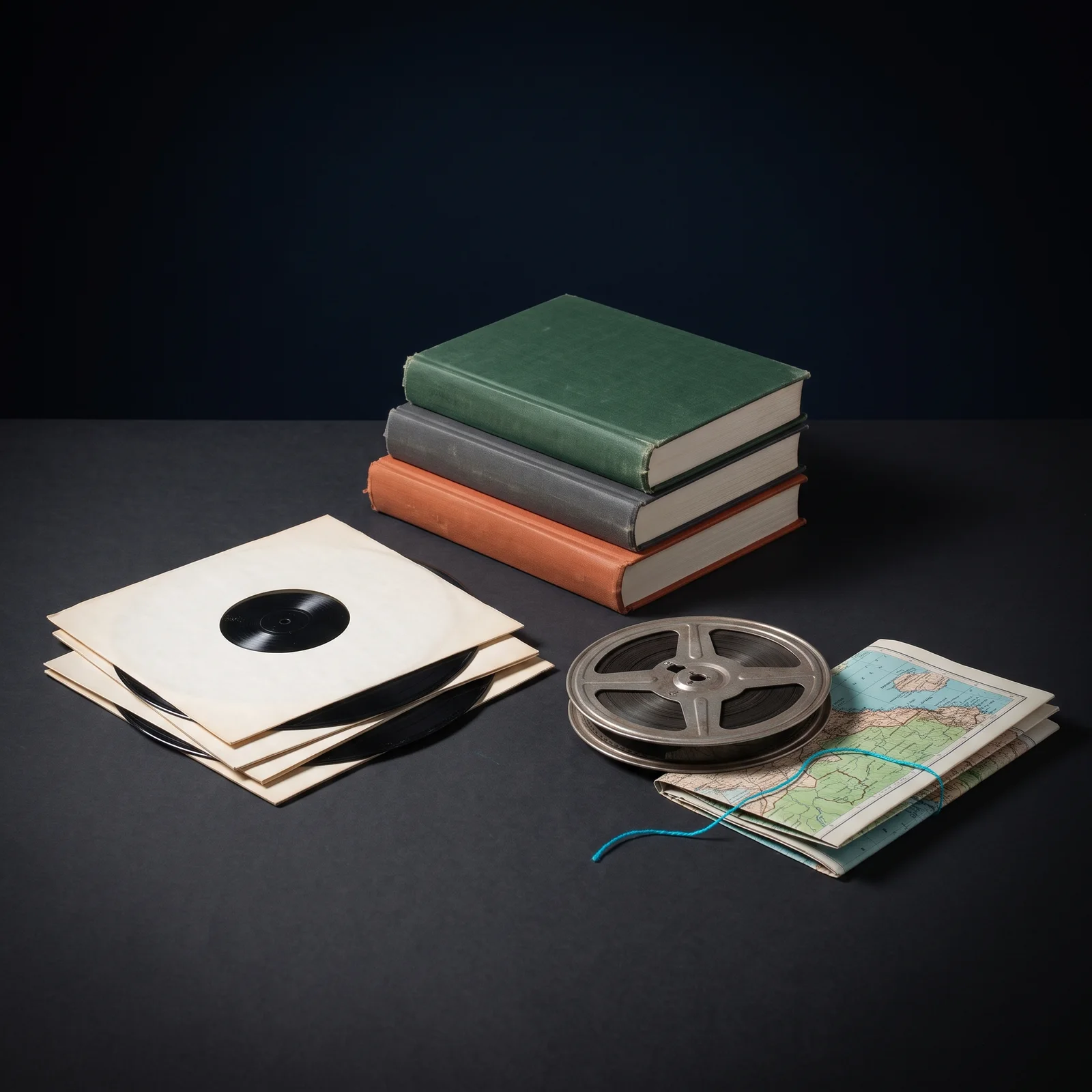
- Records, books, film. Things people keep because throwing them out feels wrong, which is not the same as wanting them.
- Other
- The sewing machine, the birdcage, the globe, the lava lamp. The things a category list was never going to cover.
- A category is a door, not a shelf.
- You are not shopping in one. Your thing has a band, and the band cuts across all eight — a bicycle wheel can become a stack of records if the numbers agree.
A category is a door, not a shelf.
The offer
The offer is the whole message
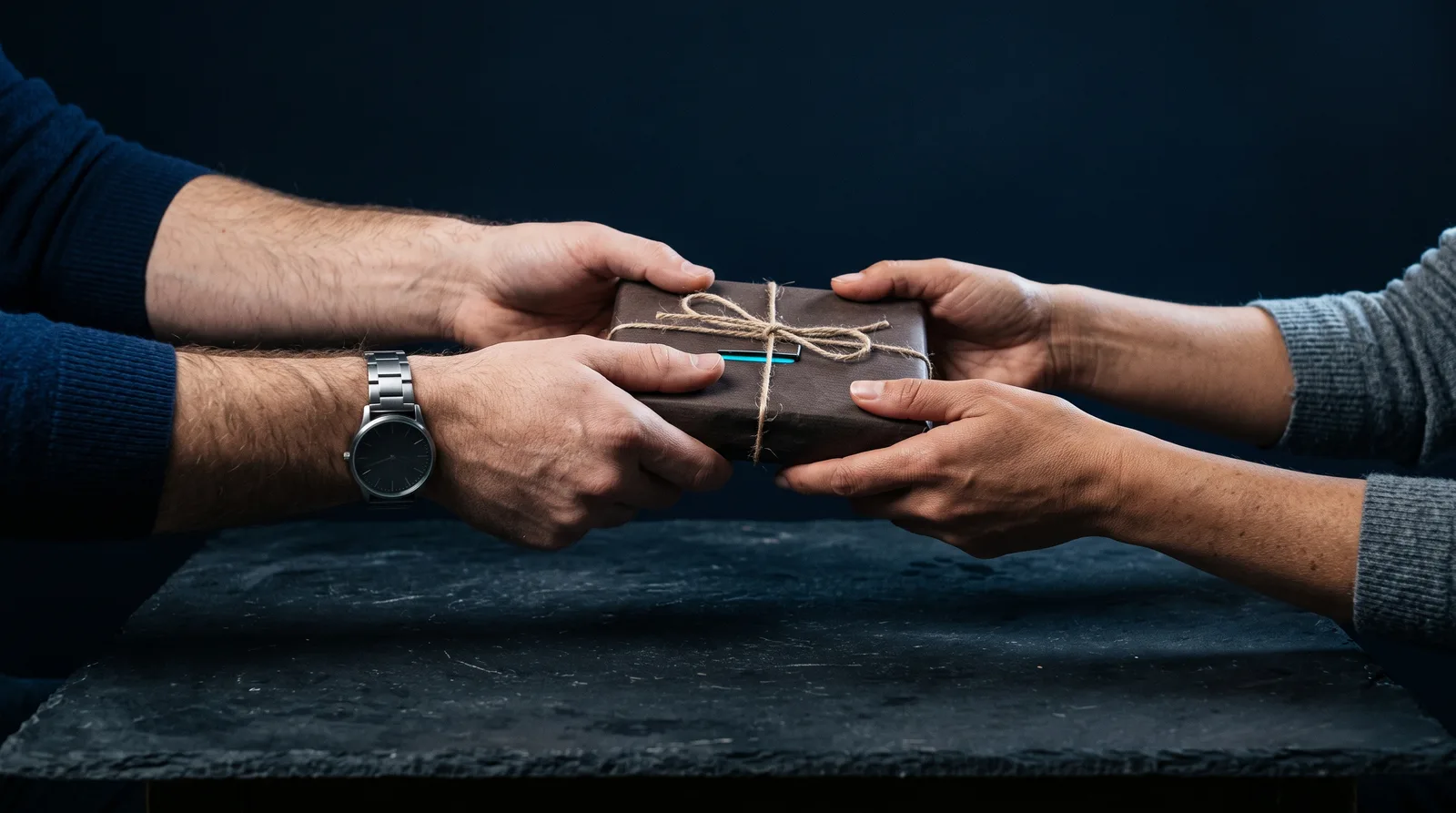
You put things on each side, send it, and the other person answers once for the whole arrangement. No haggling thread, no opening pleasantries, no phone numbers.

- You make an offer
- One of your things for one of theirs, or several for several — up to twelve items on the asking side. Both bands are shown, so you can both see the shape of it before anybody agrees.
- They accept, decline, or say what was wrong
- A decline can carry a short reason chosen from a list, so you know whether you were close. If it was not right, send a different offer rather than asking about it.
- Chat opens on acceptance, and not before
- This costs something and it is worth naming what. An open message box on an offer nobody agreed to is the cheapest way to reach a stranger who never asked to be reached.
- You meet, and you both confirm
- Both of you say the handover happened, and only then does it count as done. Neither person can claim a completed swap alone.
- Either of you can call it off.
- Right up until somebody confirms the handover. The items go straight back to the people who put them up, and back onto the site exactly as they were.
- Keeping an eye on something
- Every item somebody else holds carries “Keep an eye on this” beside the swap button. It saves the item to a list at the bottom of your vault and does nothing else — it reserves nothing, joins no queue, and tells the owner nothing about you.
- Once somebody has confirmed
- The cancel button goes. At that point a person is saying the exchange physically happened, and unpicking that is a disagreement between two people rather than something a button should settle.
Either of you can call it off.
The circle
A swap meet that assembles itself
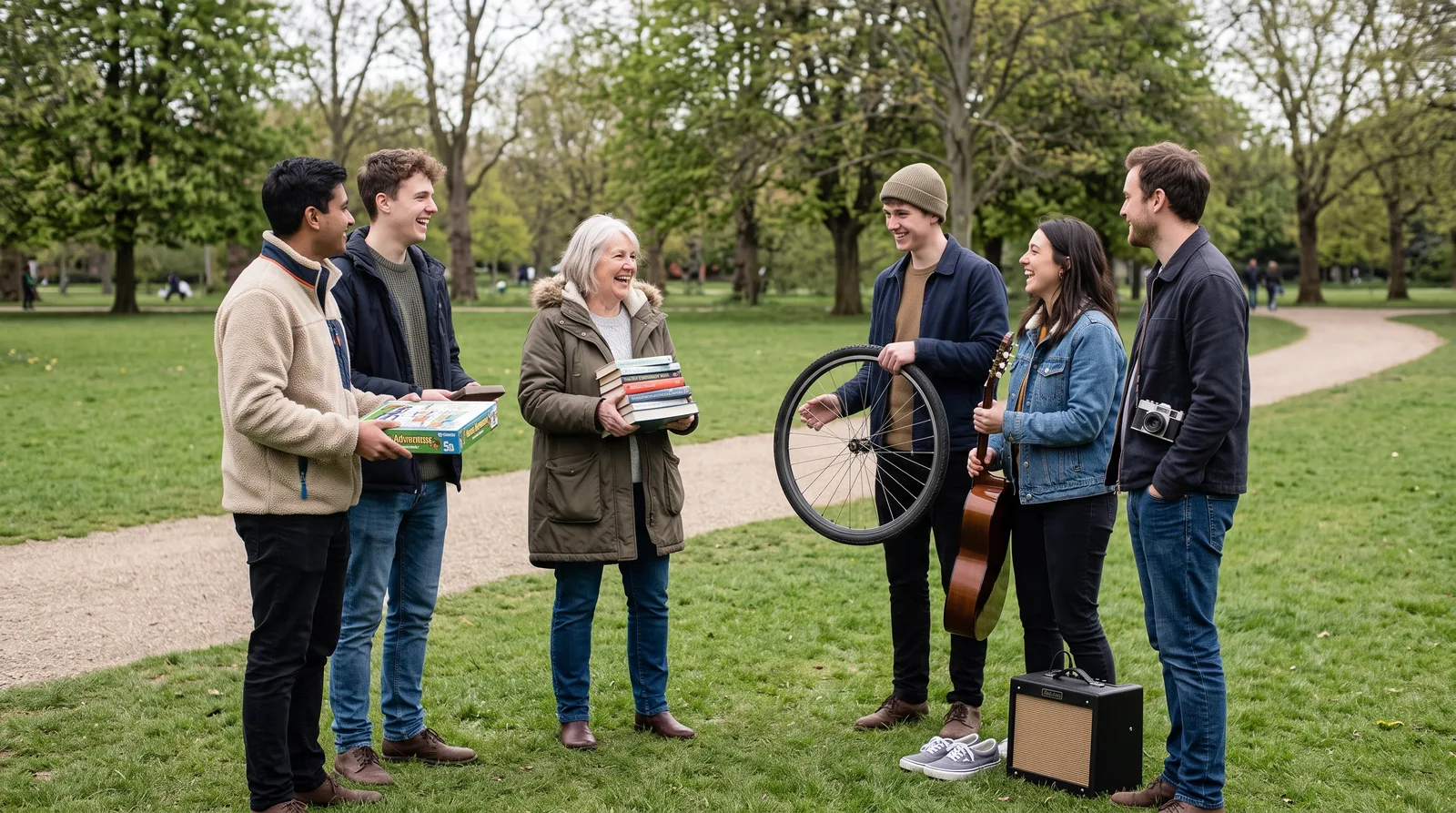
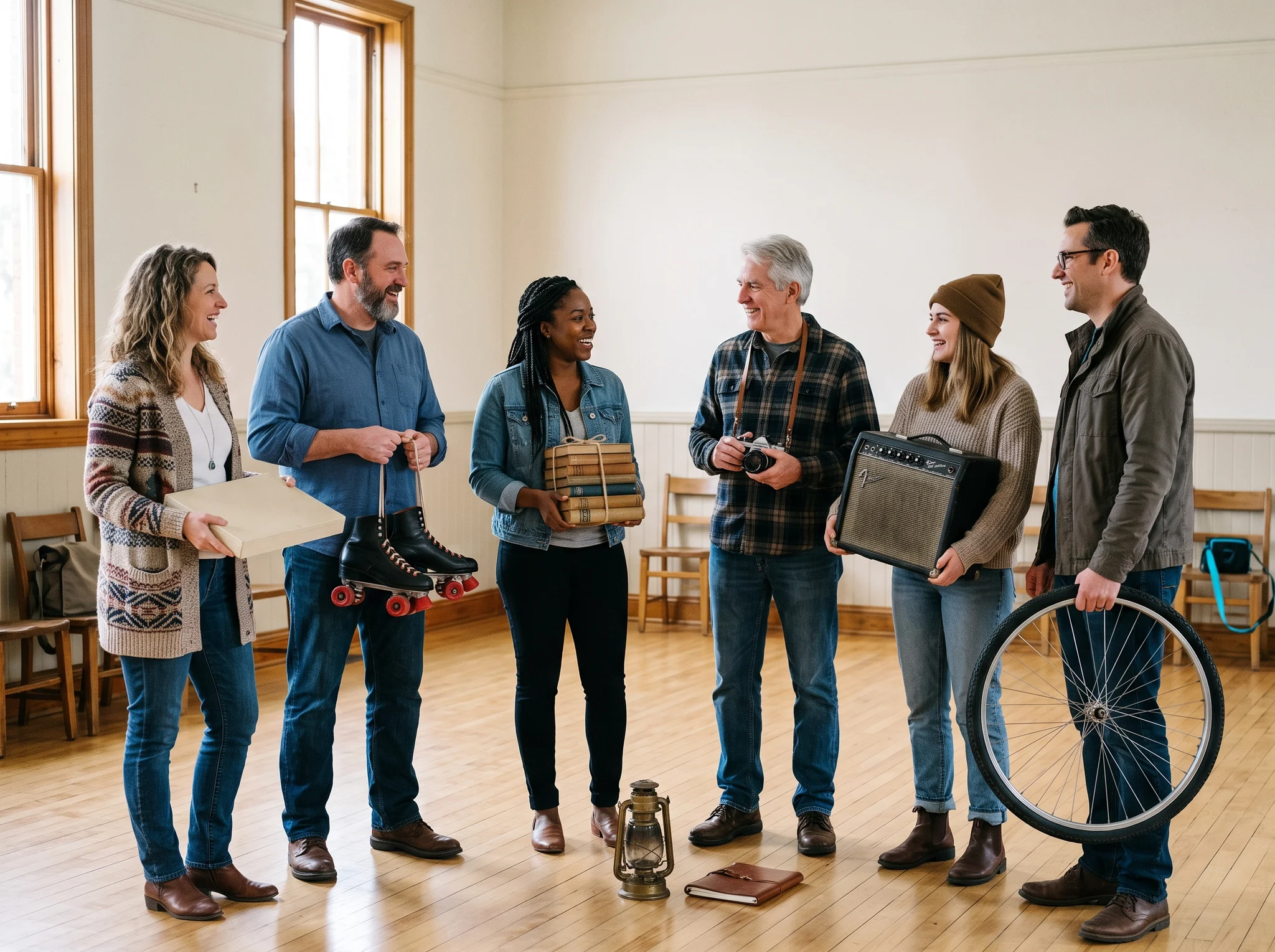
Several people, one place, one afternoon, and everybody goes home with something. Nobody books a hall, prints a flyer or runs anything.

- How one comes together
- You have a guitar you have stopped playing and you would like almost anything else. You open it up rather than waiting for one person to want exactly your guitar. What you put in sets the range everything else has to land in.
- Six people. One park.
- The reason this works where a two-person swap sometimes does not is that six people have far more ways of matching up than two do. Your guitar does not have to become one specific thing. It has to become something, out of everything that turned up.
- Indoors works too
- A hall on a Saturday morning is the same idea with a roof and somewhere to put a cup of tea. Where you meet is written down in your own words, so it can be any of this.
- What it does not do
- It does not book the venue, chair the meeting, hold anybody’s property, or take a cut of what changes hands. Joining a group does not lock your item — it stays yours and stays on Explore, and you can step back out while the group is still open.
Six people. One park.
Where you meet
Somewhere sensible
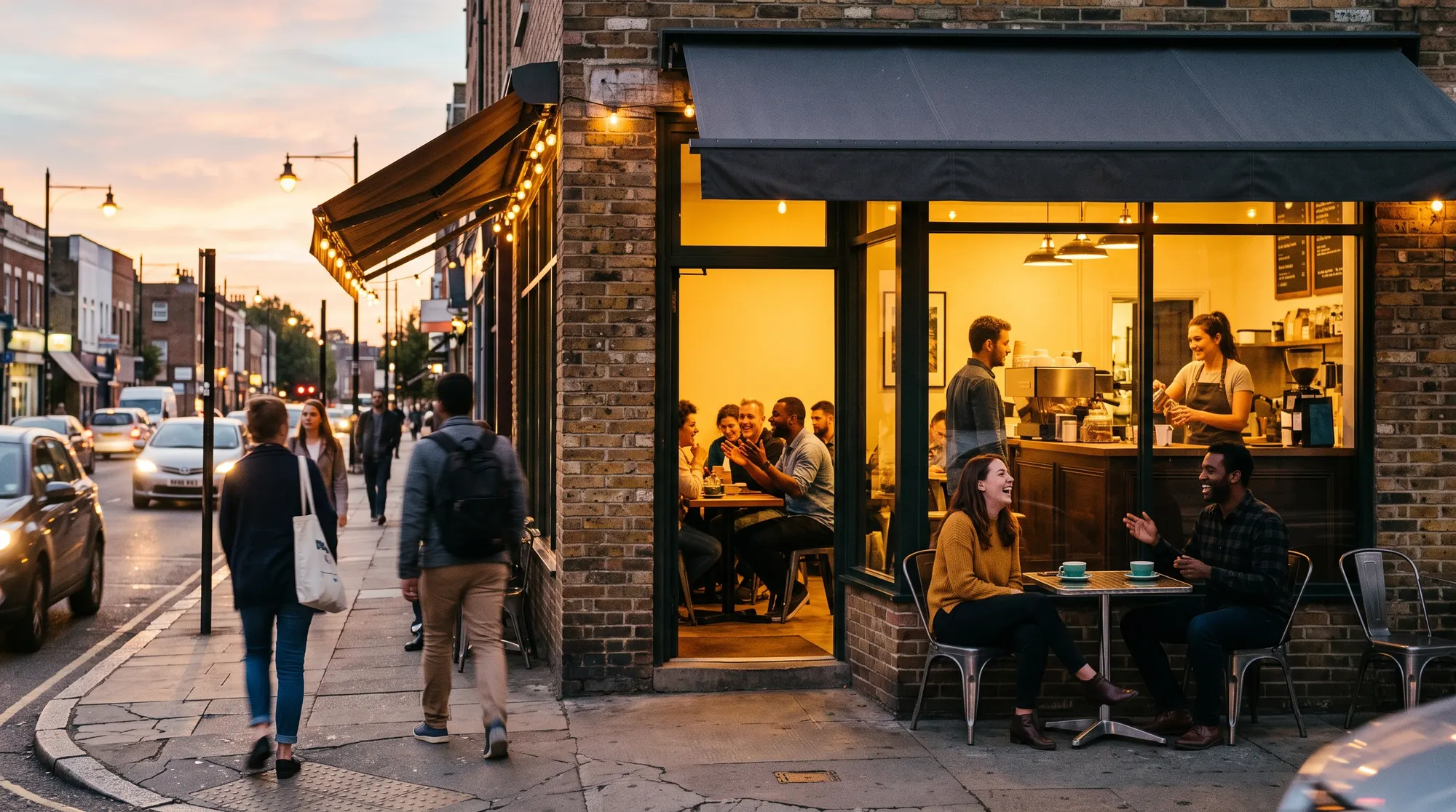
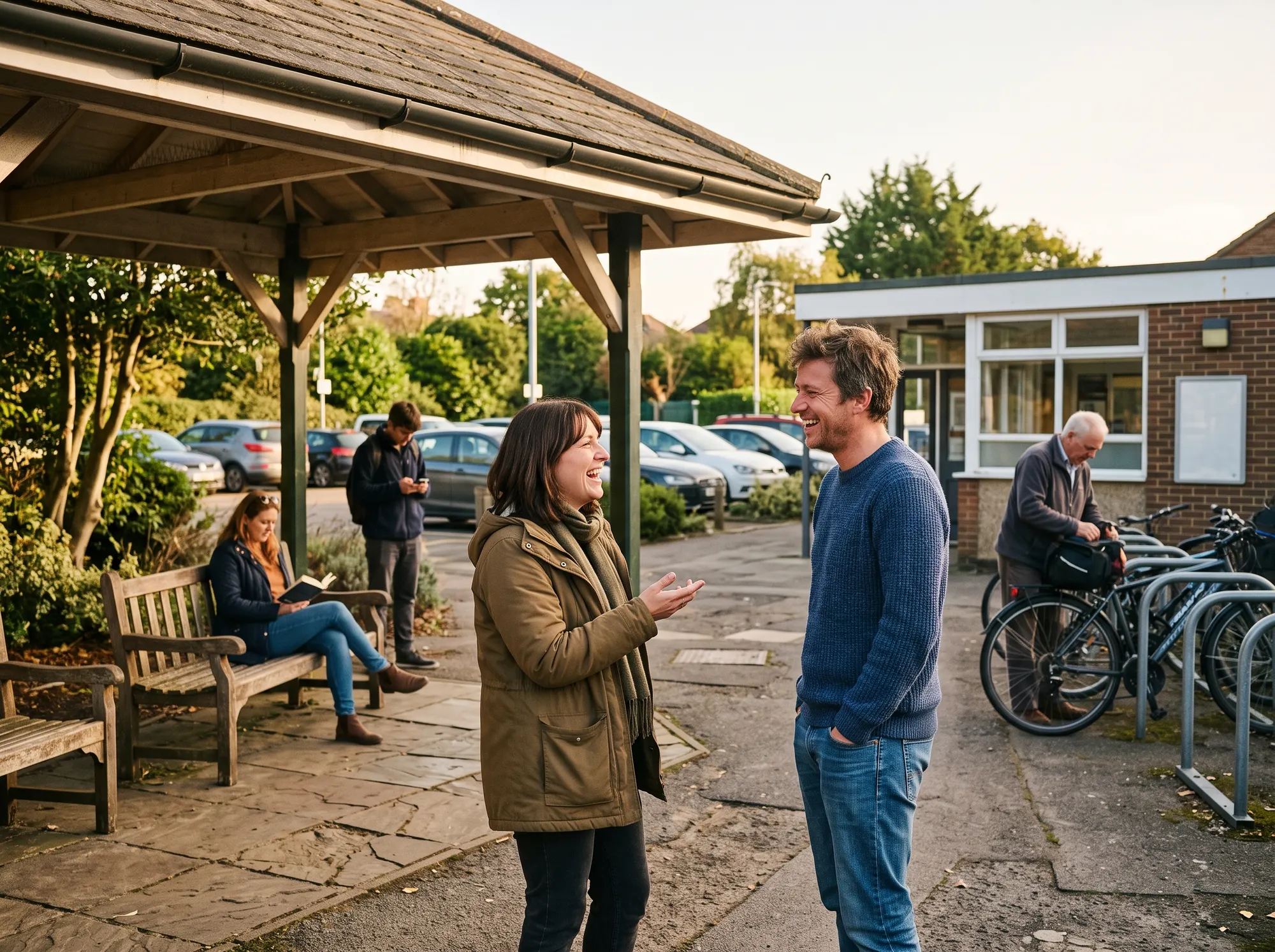
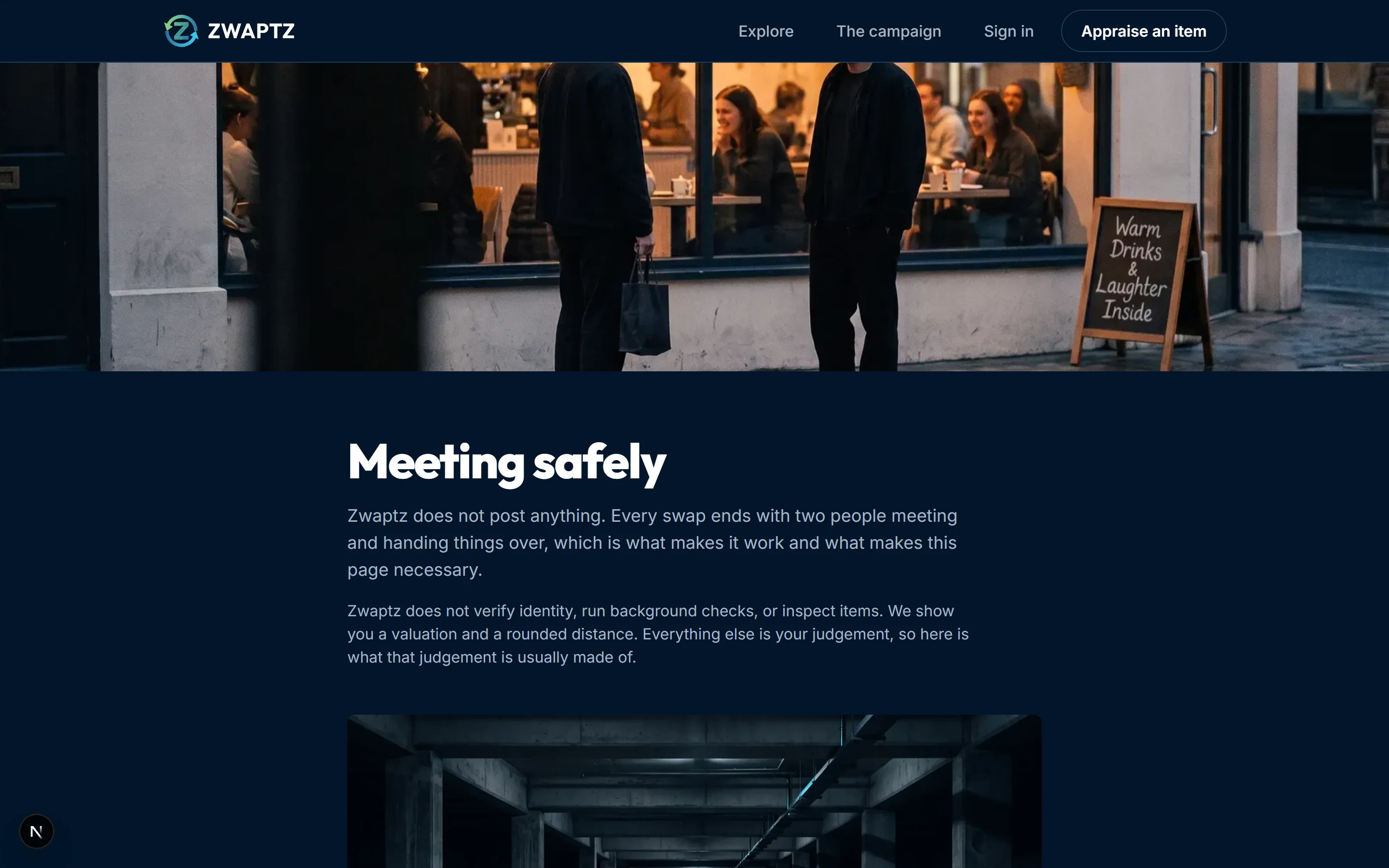
When a swap is agreed, Zwaptz suggests a few kinds of place to meet and writes the sentence for you, so arranging it does not become its own negotiation.
- What works today
- Four kinds of place — a police station’s marked exchange bay, a station concourse, a café, a supermarket entrance — each with a sentence already written that you can edit before you send it. That is built and running.
- We never call a place safe.
- Zwaptz has not been to any of these places. It does not know who is standing in one this evening, whether the lights work, or what the road outside is like after dark.
- The kinds of place it suggests
- Four of them, each with a sentence already written that you can edit before you send it.
- Why the arrangement stays here
- Working out where to meet is the job a chat box does worst, and it is the exact point at which two people give up and move to another app to sort it out.
- Room for the item
- A café table is fine for a camera and useless for a rowing machine. The suggestion would account for what you are actually handing over.
We never call a place safe.
Private by default
Built to be left
The test of a product is not what it promises while you are using it. It is what happens on the day you decide to go.
- Delete everything, in one click.
- From your account page, and it is immediate. Your email address, your password, your postcode and your items go, along with their photographs.
- The two things that stay
- A swap you already completed stays on the other person’s trades page, shown as being with a deleted account. Your name is gone from it; the record of the exchange is not.
- Reporting anything
- Report sits at the bottom of every item, every profile and every swap. It reaches an administrator, who can read the conversation and suspend an account.
Delete everything, in one click.

The shed
You have one.
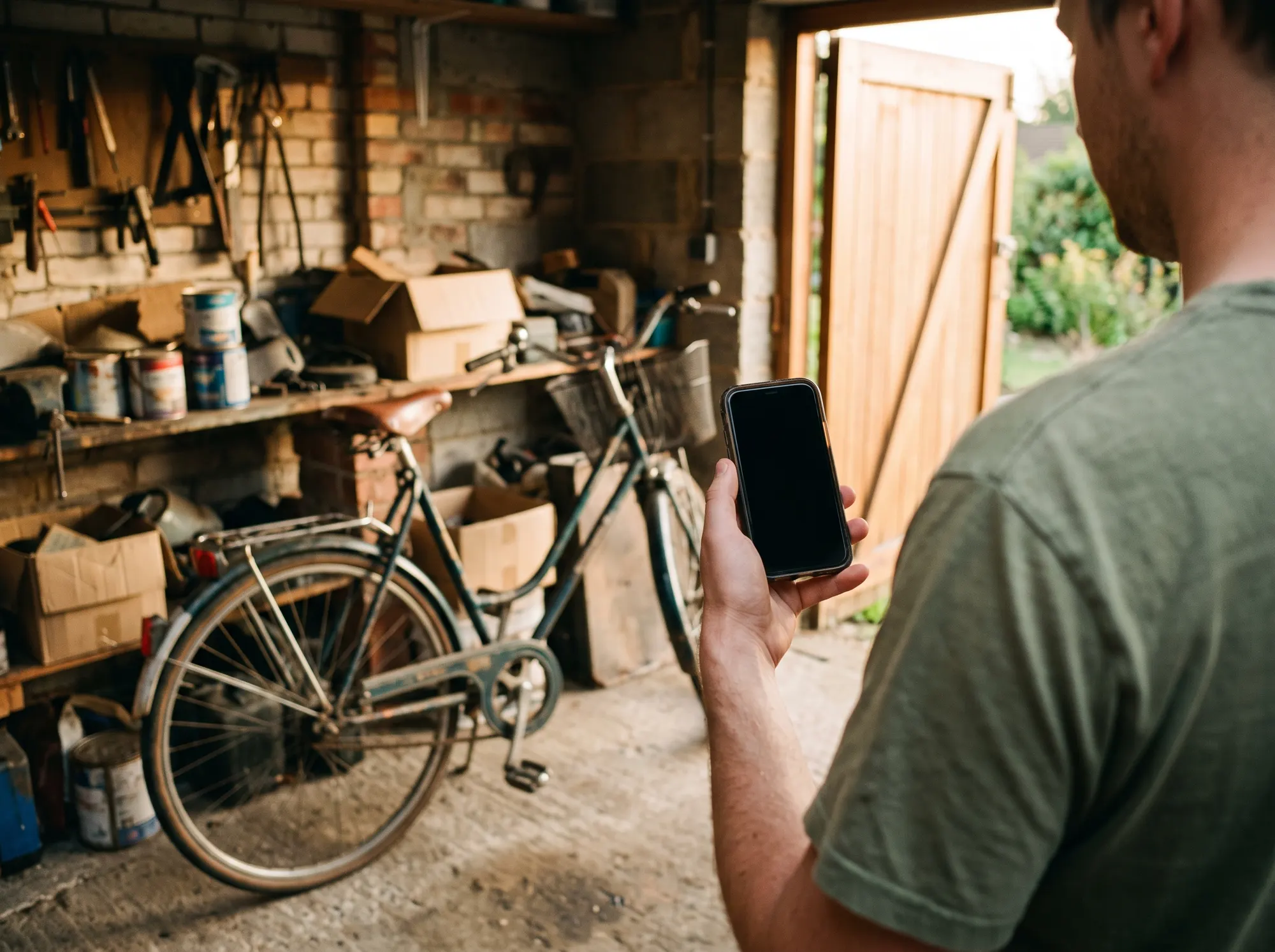
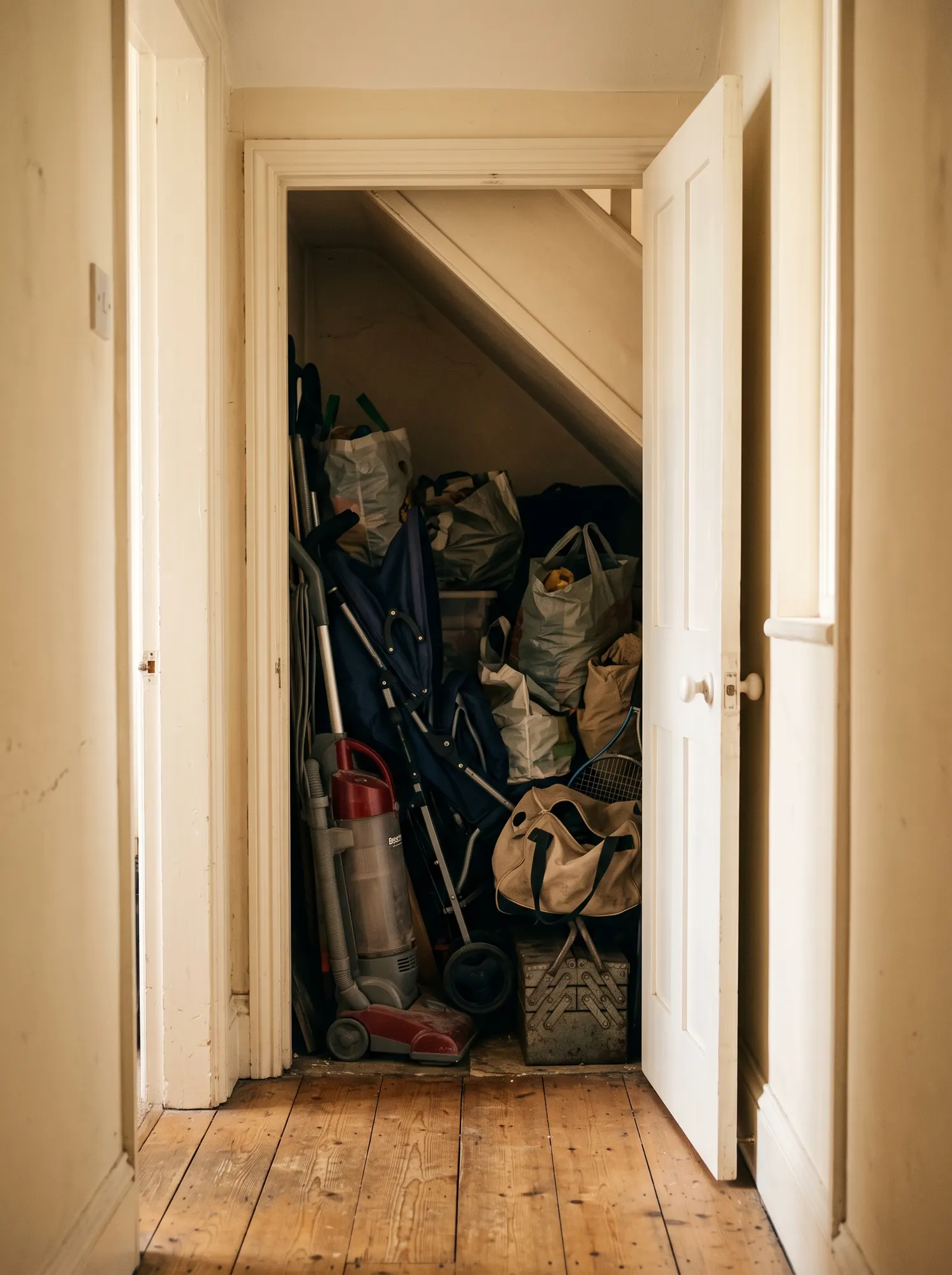
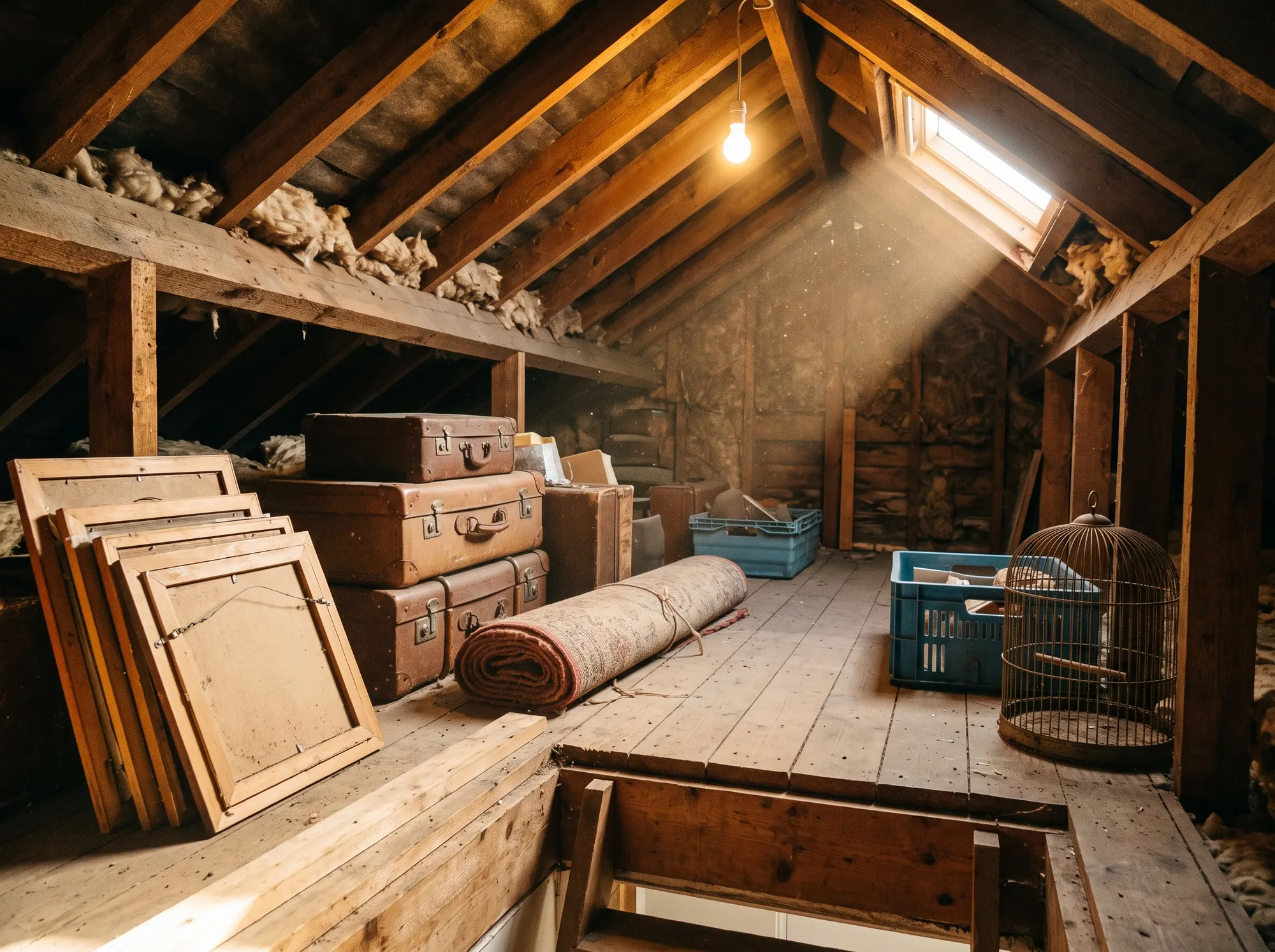
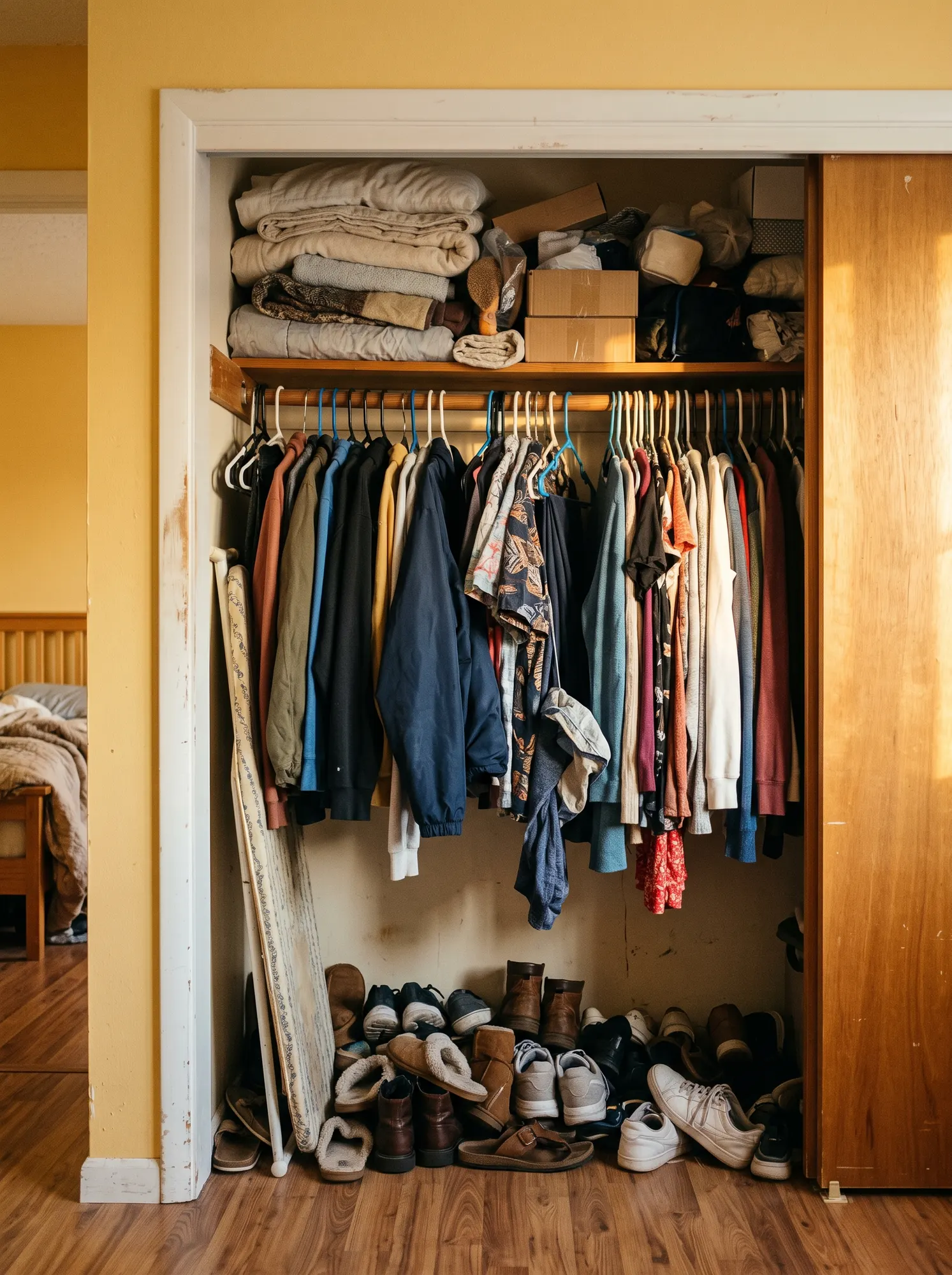
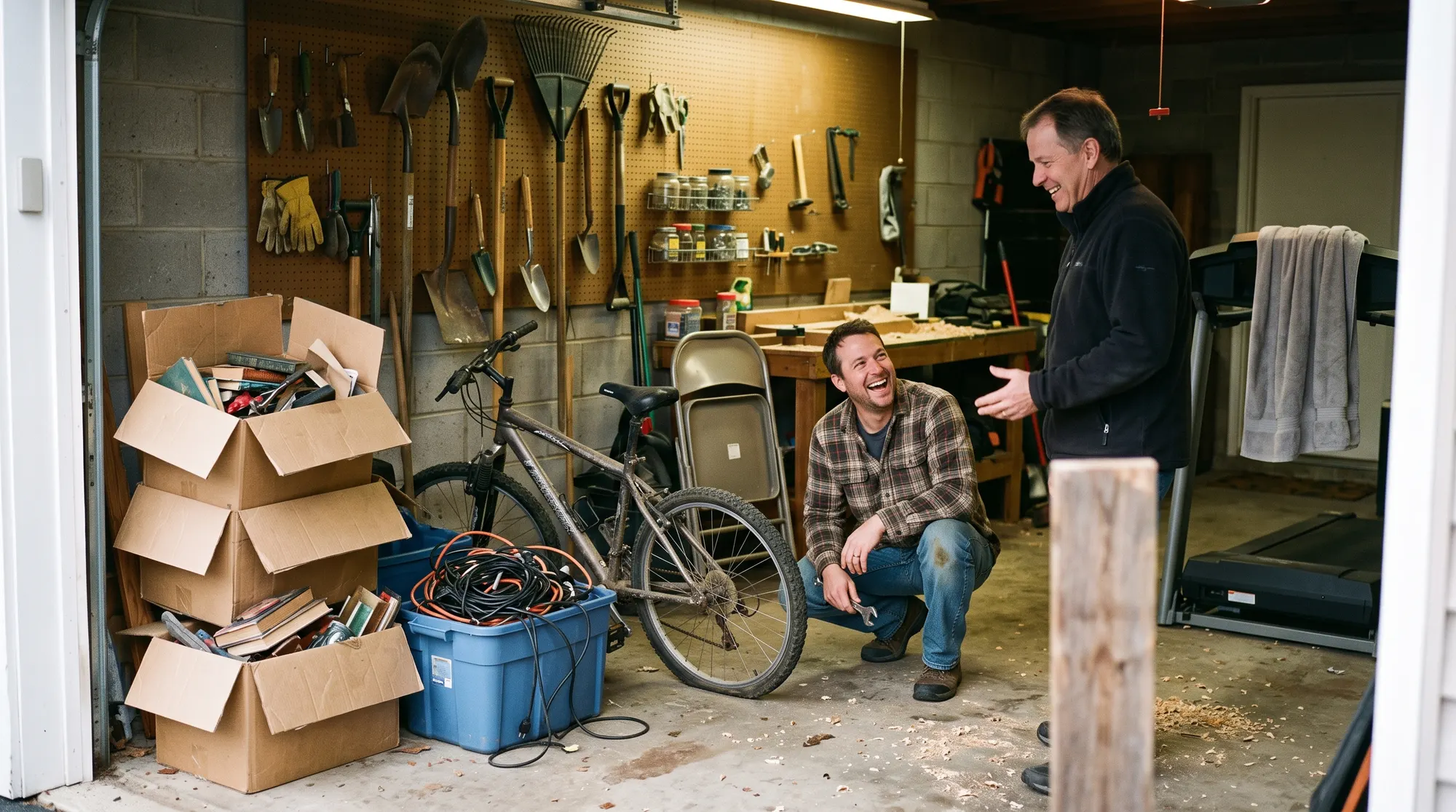
Maybe it is the garage. Maybe it is the loft, or the cupboard under the stairs, or one drawer in a dresser that you open about twice a year and close again.
- Not worth a Saturday
- You know roughly what selling it involves. Photograph it in decent light. Work out what to call it. Guess a price. Answer three people who ask if you will take half, and one who asks whether you would deliver.
- The middle option
- There is giving it away, and there is doing the work of selling it.
Almost everything in that garage is sitting there because neither one is right.
Who it's for
Four people with the same problem
They own different things, live in different places and would not recognise each other. What they share is the reason none of it has moved.
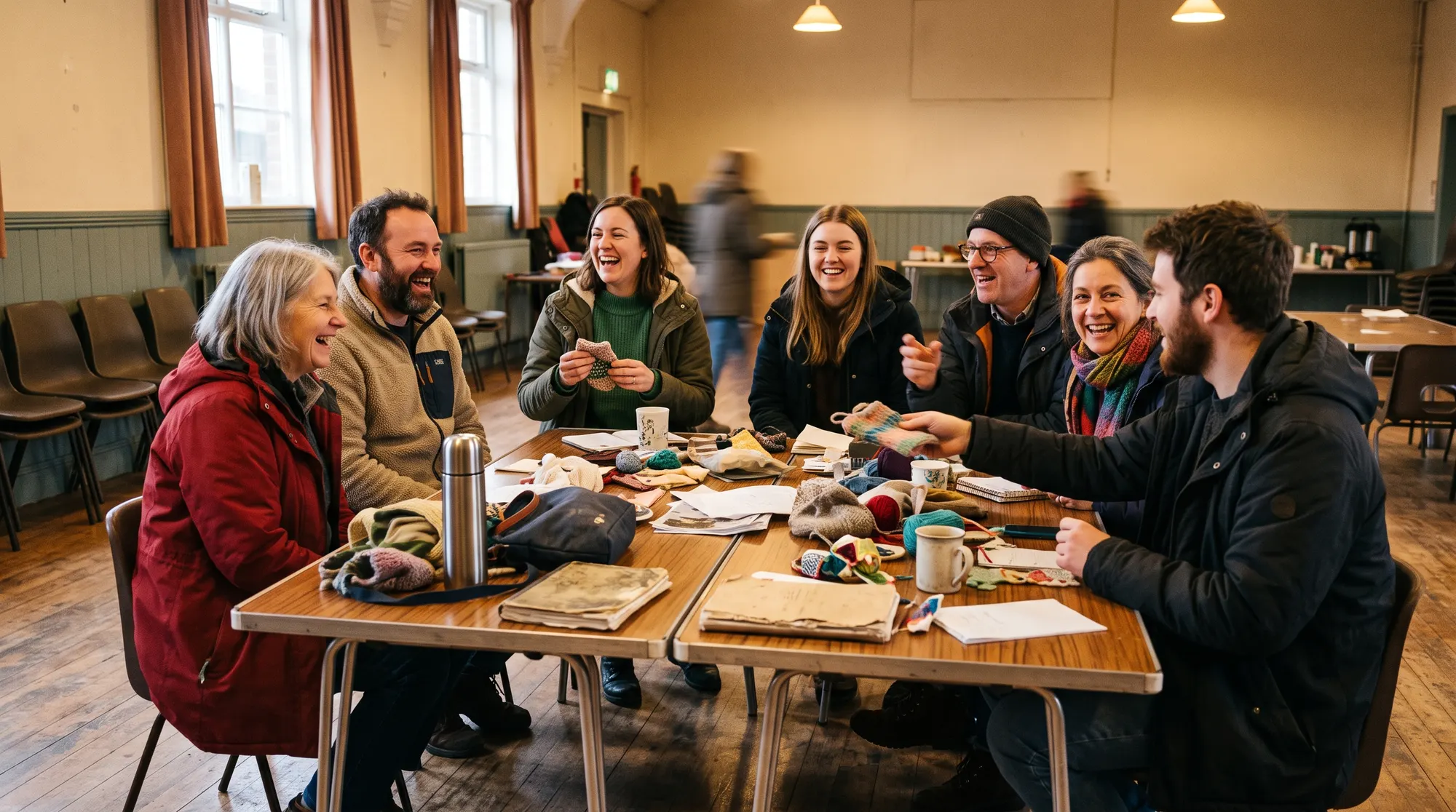
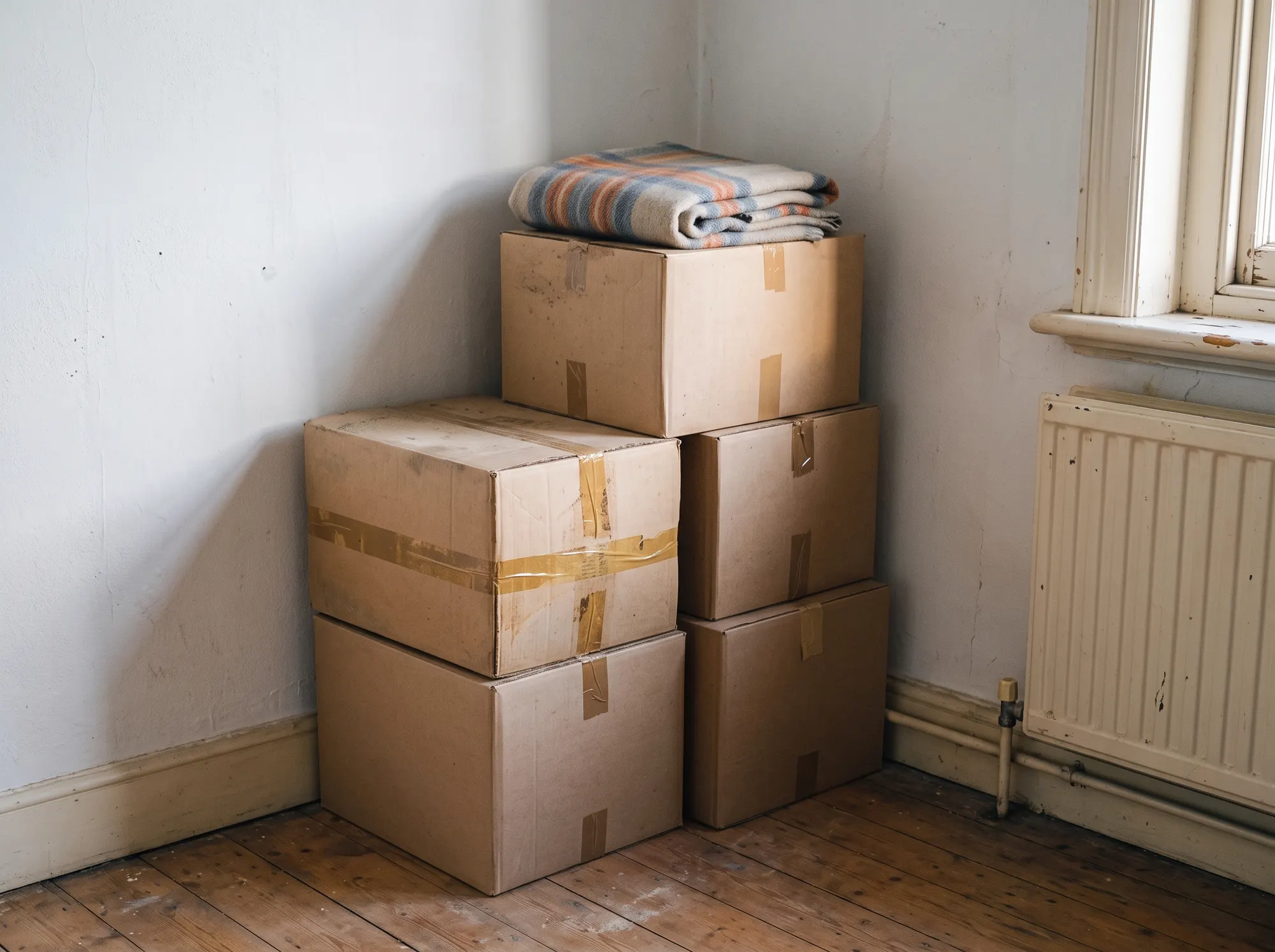
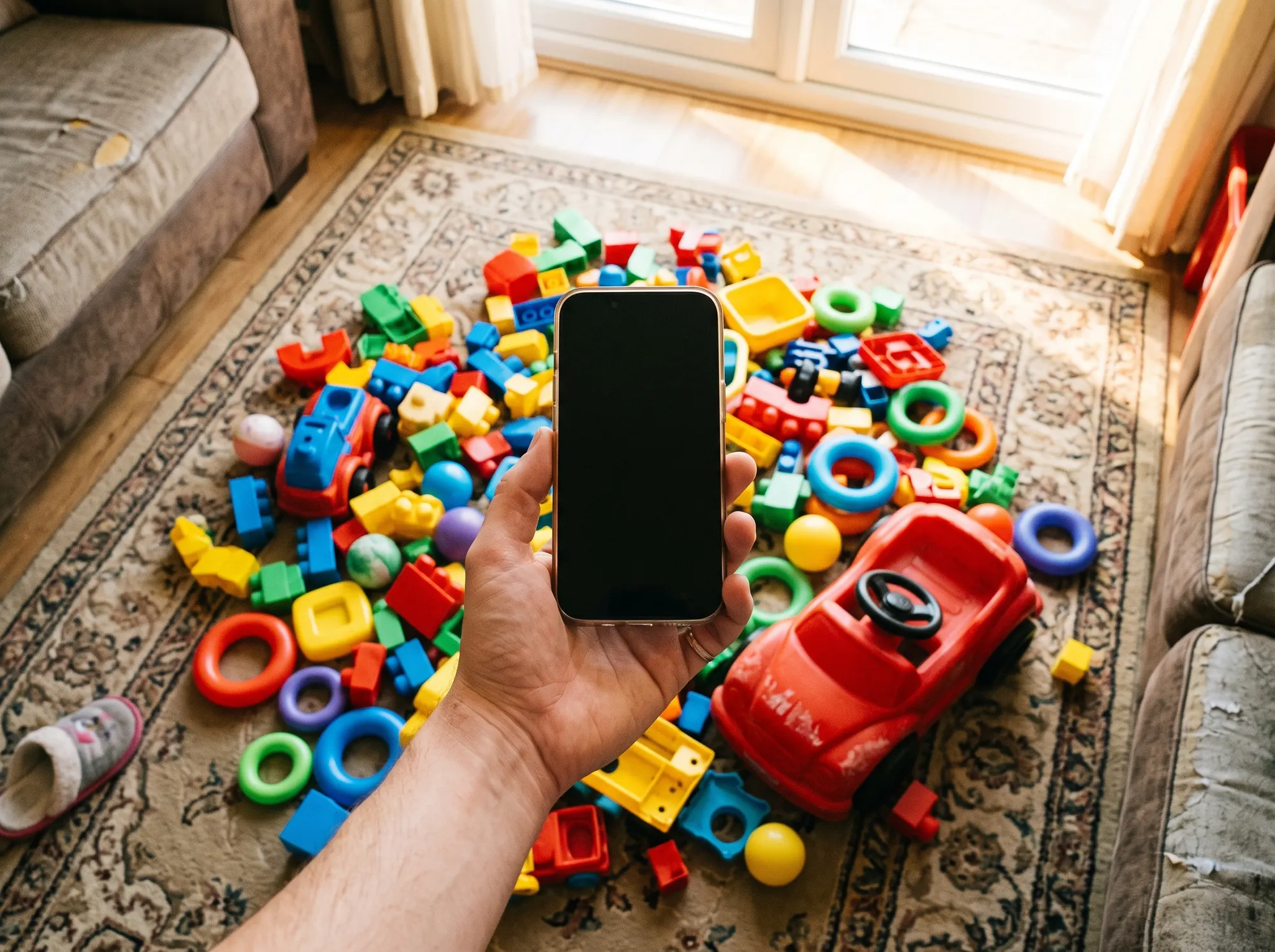
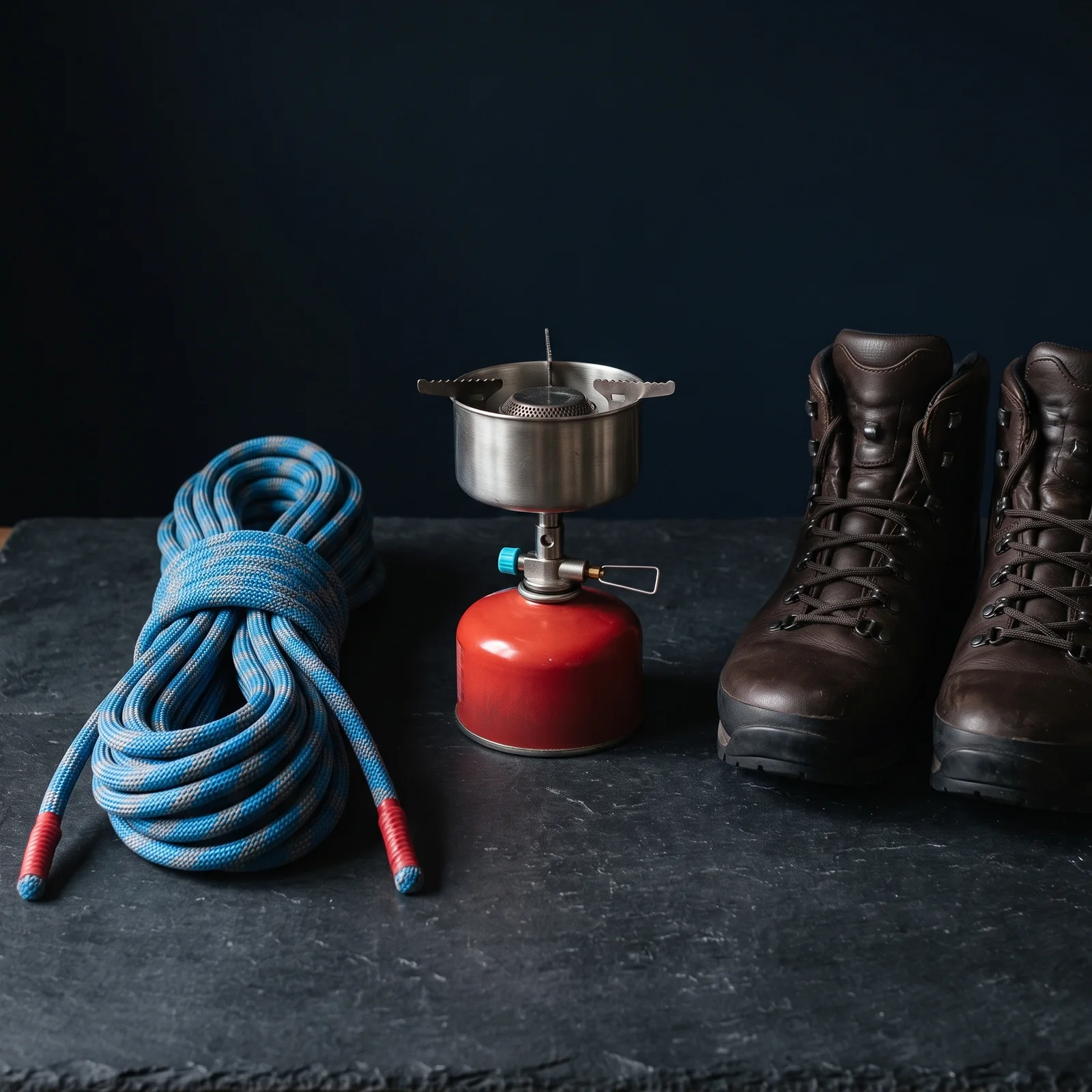
- You just moved
- Four boxes never got unpacked. You know what is in two of them and you are fairly sure about the third.
- Your children grew
- The bricks, the stacking rings, the ride-on car with a wheel that squeaks. The trike. Two scooters, one outgrown and one barely ridden.
- You moved on from the hobby
- The rowing machine. The cello, in its case, since about March. The camping stove and the rope you bought for a summer that turned out to be one summer.
- You collect, and you have doubles
- You have the spare. You have the one you upgraded from, and the one you bought because it came in a box with something else.
- None of them wants money enough to do the work.
- That is the whole overlap. Not income, not decluttering, not sustainability — those are things people say afterwards.
None of them wants money enough to do the work.
Sell or swap
Sometimes you should just sell it
Swapping is not better than selling. It is better at some things and worse at others, and pretending otherwise would waste an afternoon of yours before you found out.
- If you need cash, sell it.
- Not “consider selling”. Sell it. A swap hands you an object, and an object does not pay a bill. Everything else on this page assumes you are past that question.
- Where each one wins
- Five separate projects. Nobody does five projects.
- What swapping is actually for
- The pile of things that are genuinely worth something, individually worth less than the trouble of selling, and collectively worth quite a lot.
| The situation | Sell it | Swap it |
|---|---|---|
| You need the money | Sell it. This is not close, and nothing below changes it. | A swap gives you an object. An object is not rent. |
| How long it takes | Photograph, write, price, list, field the offers, wait in for a collection. | Photograph it, get a range, put it up. The waiting is the same; the writing is not. |
| What it is worth | You decide the number, then find out over a fortnight whether you were right. | You get a range with a stated confidence before you commit to anything. |
| Rare, high-value, or collected | Sell it. A specialist auction knows buyers you cannot reach, and the fee is worth it. | The band around a rare thing is wide, which makes an even trade hard to judge. |
| Big, heavy, or awkward | A courier quote is often more than the item. Local sale, cash, and hope they turn up. | You are meeting somebody local anyway. The size stops being the problem. |
| You want a different thing | Sell yours, wait for the money, then start again as a buyer. | One arrangement instead of two. This is the case Zwaptz is built for. |
If you need cash, sell it.
Real trades
Four worked examples, including an awkward one
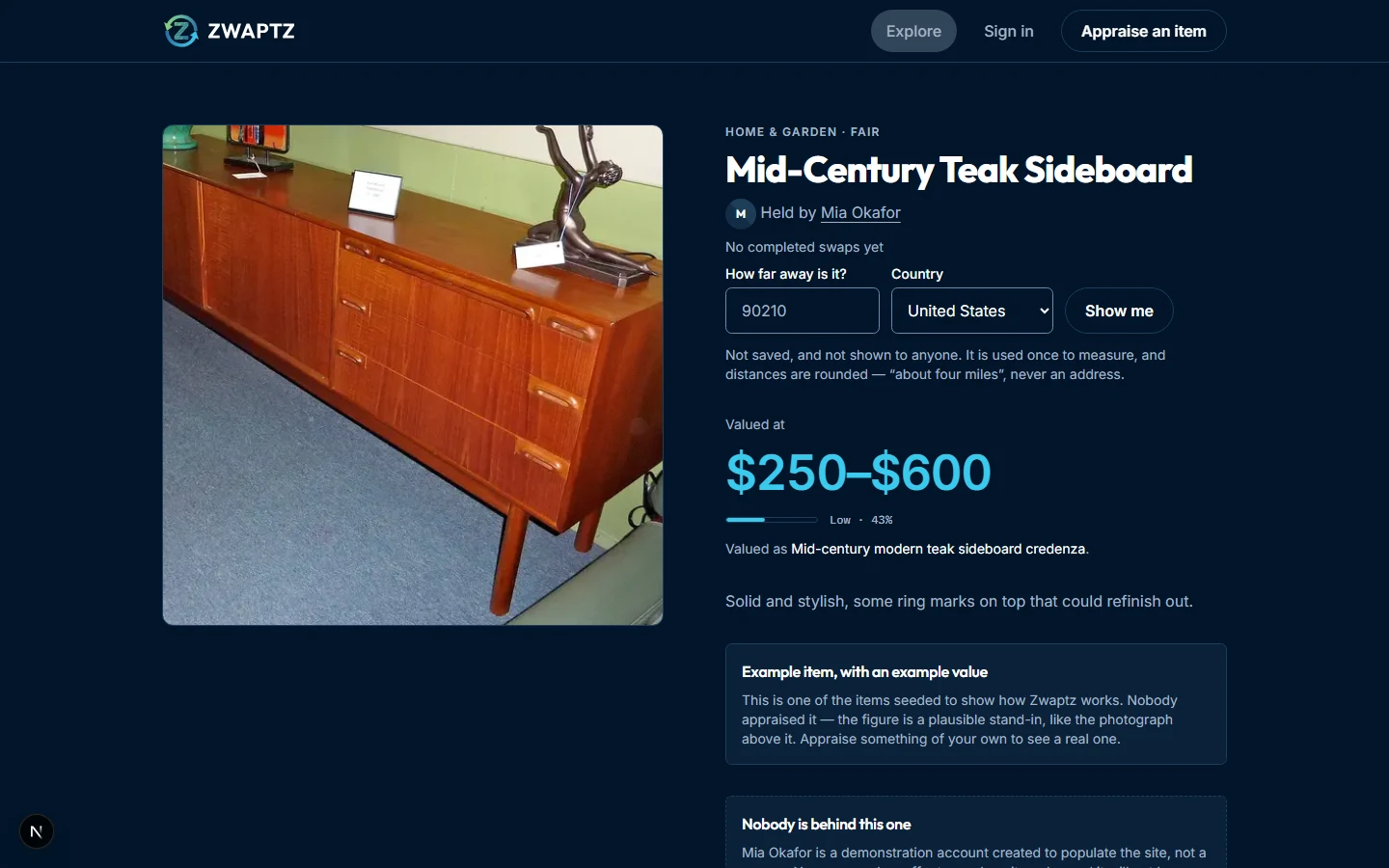
Four objects, four bands, and what each one turned into. The figures are illustrative — they show how a band is read, not swaps that have happened.
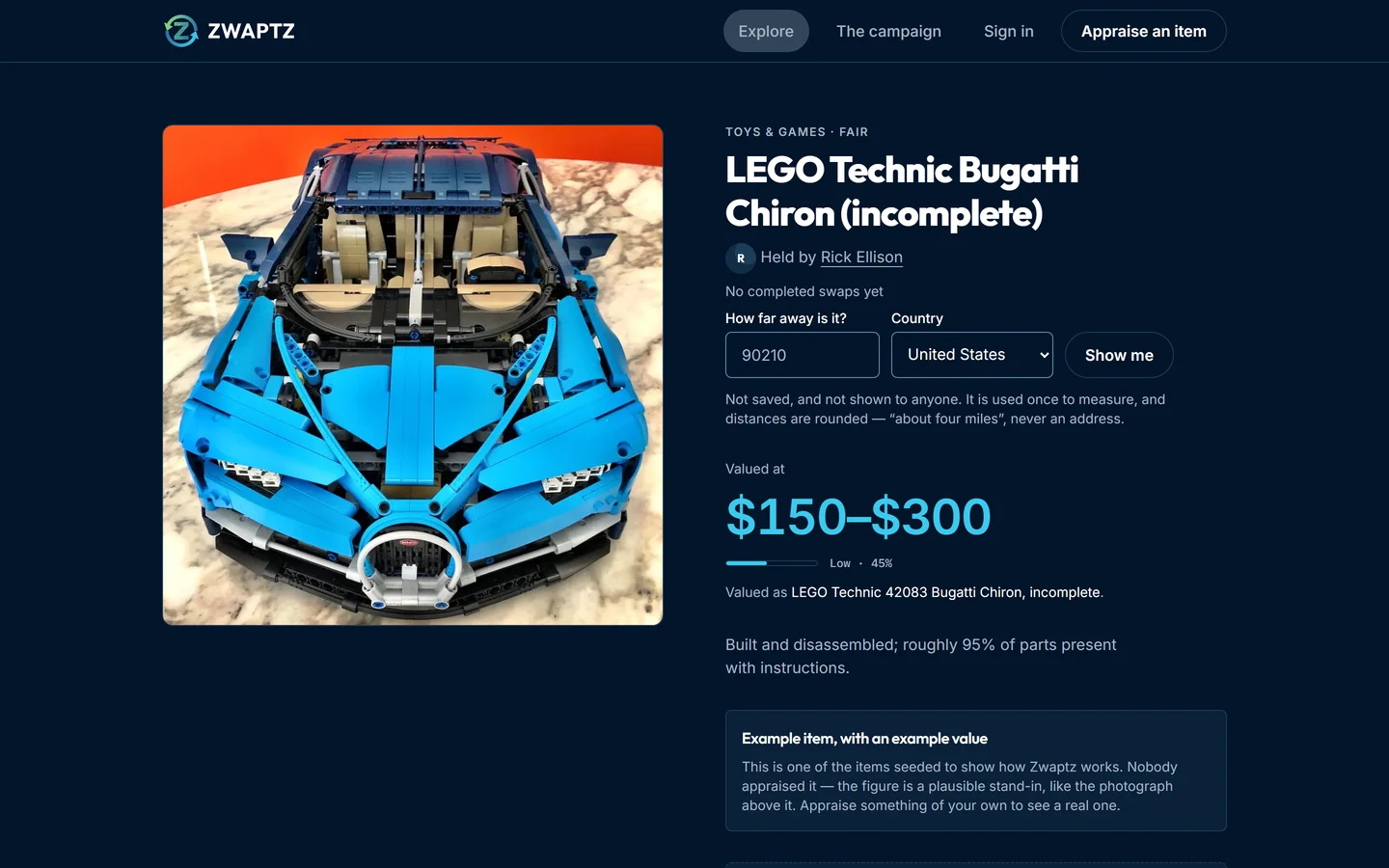
- A bread maker, used four times
- Boxed, with the paddle and the manual. Six years old, working.
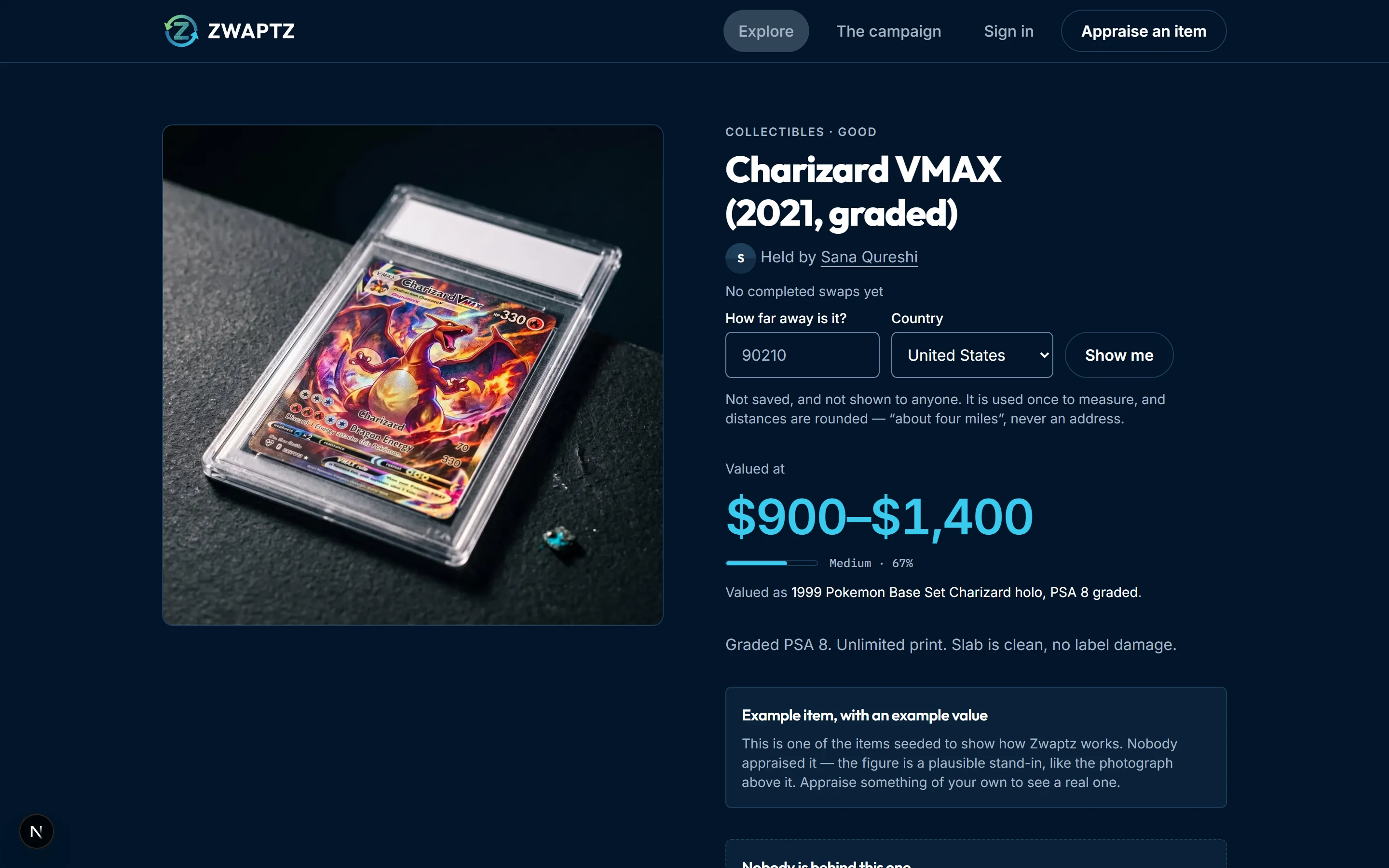
- Two children's scooters
- One outgrown and scuffed, one barely ridden. Both fold.
- A road bike frame and a spare wheel
- Aluminium, one dent in the down tube, wheel true.
- A folding pocket knife, brass and rosewood
- No maker's mark that the photograph could read. Older than fifty years, possibly much older.
- A wide band is an answer.
- The knife is not a failure of the valuation. It is the valuation saying, accurately, that it could not read a maker’s mark and that the difference between the two readings is a factor of ten.
- Band
- $120–$190
- Confidence
- Medium
- Band
- $25–$260
- Confidence
- Low
A wide band is an answer.
Try it first
Try it before you back it
Most campaigns ask you to imagine something that does not exist yet. This one is already running.
- The goal is small on purpose.
- $8,000 is what it takes to finish the things named on the roadmap and run them for a first year. It is not a number chosen to sound ambitious.
- What is already built
- Appraisal, with the reasoning shown and a confidence figure beside every range. A private vault. Browsing by distance without an address ever appearing. Offers, bundles, two-sided handover confirmation, reporting, and account deletion that actually deletes.
- Why it was built
Because a thing is worth something when somebody is using it, not when it is sitting on a shelf.
Selling an old skateboard is work — photographs, a listing, haggling, posting it off. Giving it away feels like a loss. So it stays in the cupboard, and that is where most of what a household owns ends up. Zwaptz is the middle: find out what the thing is worth, then trade it for something that will actually get used.
- Category
- Design, Interactive Design. Technology, Web is the secondary.
The goal is small on purpose.
Where the money goes
Where every dollar goes
Every line below is costed, and the arithmetic is shown rather than asserted. The two deductions come off the top, and the six lines they leave add up to the remainder exactly.
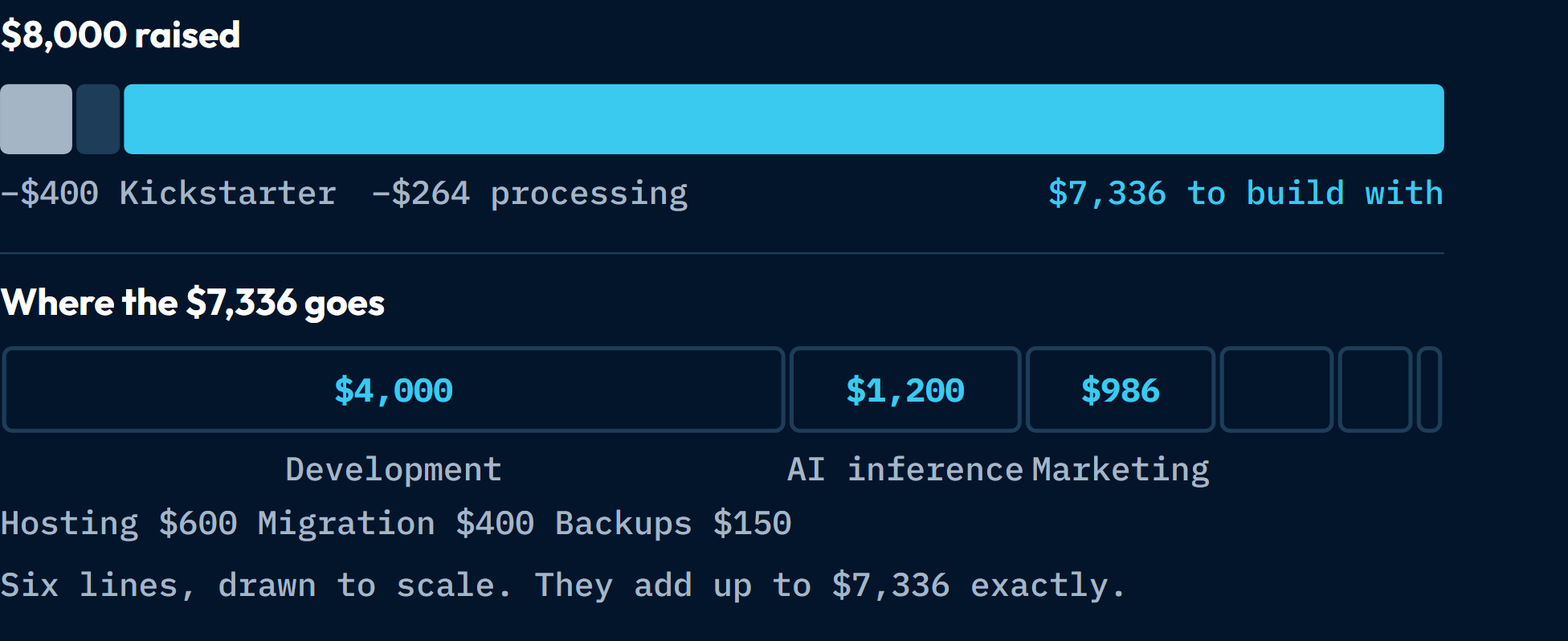
- Off the top, before anything is built
- 5% of the total raised. Fixed, and charged only if the campaign funds.
- $7,336
- Every line is costed, and the arithmetic is shown rather than asserted.
- What it is spent on
- Six lines, adding up to $7,336. Each one is a real thing that has to be paid for, and the largest by far is the work itself rather than the machine it runs on.
- Hosting
- $600
- Backups
- $150
- AI inference
- $1,200
- Marketing
- $986
What it is spent on
What gets built
What gets built, in order
Five things, in the order they get done. One of them is already done — group trades shipped on 8 September 2026, a month before this campaign closes. Each of the rest is a specific gap with a specific consequence, and the order is argued rather than assumed.
- Being able to reach you
- Because there is no way to email anybody today, and that shows.
- Backups that leave the building
- Because fourteen days of backups currently sit on the machine they protect.
- The band is what everything runs on.
- That is the whole argument for the order. Every other item on the list is a good thing to have. Comparable sales is the one that makes the number underneath all of them more trustworthy, and a swap people trust is the product.
- When
- Dates are counted from the campaign closing on 8 October 2026, not from the day it launches.
The band is what everything runs on.
What you get
What backing gets you
Nothing ships in a box. There is no product to manufacture, and a tote bag would only take money out of the roadmap.





- $10 · A permanent credit
- Trading power for 250 appraisals, or 25 completed swaps — and your name on the credits page, for as long as the site exists.
- $25 · A mark on your profile
- Trading power for 700 appraisals, or 70 completed swaps — and something on your Zwaptz profile saying you were here first.
- $50 · A VIP account
- Early access to every new feature before anybody else, and trading power for 1,500 appraisals or 150 completed swaps.
- No tier changes a valuation.
- Trading power is how much use of the site a pledge covers. It is not a better version of anything. A backer’s appraisal runs the same models, against the same evidence, and comes back with the same range and the same confidence as anybody else’s.
- Stretch goals
- Past the goal, more money buys more of the roadmap, sooner. That is the whole mechanism — there is no separate list of unlockables waiting behind a number.
No tier changes a valuation.
One week
One week
Seven days from the campaign closing to backers being on the new machine. Not a quarter, not “in the new year”.

- Move to a bigger machine
- The site currently runs on a box sized for a demonstration. Backers arriving is the first time it has to be sized for people.
- Backups, and restoring from them
- Nightly backups, integrity-checked, copied off the machine they protect. Today every copy sits on the same disk as the thing it is backing up, which is the single most consequential gap on the list.
- Live for backers
- Names go on the credits page. Anyone whose tier includes the build log receives it as a document.
- A backup you have never restored from is a hypothesis.
- That line has been at the top of the backup script since long before this campaign, and it is why two of the seven days are spent on something no backer will ever see.
- Counted from when
- The two features on the roadmap are not part of this week and are not claimed to be. Delivery week is the move, the backups and the credits — the roadmap is the year.
A backup you have never restored from is a hypothesis.
Straight answers
Risks, challenges and questions
Everything below is either a real risk or a real limitation, written out rather than summarised. The things that are not settled say so.
- Risks and challenges
- Their prohibited list rules out spaces whose primary purpose is selling or re-selling items. Zwaptz sells nothing, takes no cut and handles no money between the two people in a swap. The tiers do carry trading power — usage of the site, paid up front — and that is the part of this campaign a reviewer is most likely to question. We are not the ones who decide, and it has not been put to them yet.
- Questions
- Every account gets five free appraisals a week. Appraising beyond that, and completing a two-person swap, both draw on tokens — the site’s own usage credit. A group trade costs nothing at any stage: opening one, joining one and finishing one are all free. No money changes hands between the people in a swap either way: nobody pays anybody, and Zwaptz never touches a payment between you.
- Can I delete everything?
Yes, immediately, from your account page. The one exception is a swap you already completed, which stays on the other person’s page attributed to a deleted account — privacy says why.
- When does the campaign start?
Tuesday 8 September 2026. It runs for thirty days and closes on Thursday 8 October 2026. Delivery is one week after that, on Thursday 15 October 2026.
- Why was this built?
Because a thing is worth something when somebody is using it, not when it is sitting on a shelf. Most of what a household owns stops being used long before it stops being useful.
Selling it is work — photographs, a listing, haggling, posting it off. Giving it away feels like a loss. So it stays in the cupboard. Zwaptz is the middle: find out what the thing is worth, then trade it for something that will actually get used.
Everything described on these pages either runs today or is marked as not built. You can go and appraise something before you decide whether to back it.
Nothing on this site assumes the answer.